The Floor · Taiwan
LABOUR LAW · 2026
Regular day off (例假) in Taiwan: which day it is, how it differs from a rest day, and pay (2026)
In Taiwan, the regular day off (例假) is one of the two days off that Article 36 of the Labor Standards Act gives a worker in every 7 days, and the law does not tie it to Sunday or to any other weekday. An employer may not have anyone work on it, even with the worker's consent, except for a natural disaster, accident or emergency under Article 40, and then the wage is doubled and a day of rest is given afterwards. Below: how it differs from the rest day (休息日), a worked pay example, and how to check a roster.
This is a summary of the law, not legal advice. It follows the Labor Standards Act and the Ministry of Labor's (勞動部) published answers, checked on 2026-11-23.
1. What does 例假日 (regular day off) mean?
Article 36(1) reads: "a worker shall have two days off in every seven days, one a regular day off (例假) and one a rest day (休息日)." This is the rule people call 一例一休 ("one regular day off, one rest day").
- The regular day off (例假) is the compulsory one. The Ministry of Labor says it breaks up long runs of work to protect health, and the employer may not take it away.
- The rest day (休息日) is the other one. Work on it is possible with the worker's consent, paid at the rest-day rates in Article 24(2).
Under Article 39 the employer pays the wage for both days as usual; for monthly-paid staff, the monthly salary already covers them. The Ministry of Labor adds that part-time staff and student workers have the same right. The full 一例一休 rule set is in labour law and scheduling 101.
2. Which day is the regular day off? Does it have to be Sunday?
No. The law requires one regular day off in every 7 days and names no weekday. The Ministry of Labor says the employer and worker agree on the days to suit the business and the worker, and that they are not restricted to Saturday or Sunday. Many companies make Sunday the 例假: that is an agreement, not the law. Write it into your work rules or contract.
What has to stay fixed is the 7-day cycle. The Ministry of Labor says its start and end are agreed, counted on the calendar without a break, not restarted at a new month, and not moved at will. Moving a day off inside the cycle needs the worker's agreement, and in the normal cycle nobody may work more than 6 days in a row.
The exception is flexible working hours (變形工時) in Article 36(2), for designated industries, with union or labour-management meeting (勞資會議) consent under Articles 30 and 30-1:
- 2-week arrangement (Article 30(2)): at least 1 regular day off in every 7 days, and at least 4 regular days off and rest days together in every 2 weeks.
- 8-week arrangement (Article 30(3)): at least 1 regular day off in every 7 days, and at least 16 together in every 8 weeks.
- 4-week arrangement (Article 30-1): at least 2 regular days off in every 2 weeks, and at least 8 together in every 4 weeks.
3. Regular day off vs rest day: what is the difference?
Both are paid days off. The difference is whether work may be scheduled at all, and what it costs if it is.
| Question | Regular day off (例假) | Rest day (休息日) |
|---|---|---|
| Can the employer schedule work? | No, except for a natural disaster, accident or emergency under Article 40 | Yes, with the worker's consent |
| Does the worker's consent make it legal? | No. Ministry of Labor: not even with the worker's consent | Consent is needed, plus Articles 24, 32 and 36 |
| Pay when not worked | Paid as usual (Article 39) | Paid as usual (Article 39) |
| Pay when worked | Article 40: wage doubled, plus a day of rest afterwards | Article 24(2): an extra 1⅓ of the hourly wage or more for the first 2 hours, an extra 1⅔ or more after that |
| Counts toward the 46-hour monthly overtime cap? | Article 36(3) speaks of the rest day alone; the regular day off cannot be scheduled in the first place | Yes (Article 36(3)), except work caused by a natural disaster, accident or emergency |
| If the rule is broken | Article 79: fine of NT$20,000 to NT$1,000,000 | Article 79 also covers Articles 24 and 32, same fine range |
The Article 32 cap is 46 overtime hours a month (with union or meeting consent, up to 54 in a month and 138 in every 3 months).
4. Can staff work on a regular day off?
As a rule, no. The one exception is Article 40: when a natural disaster, an accident (事變) or an emergency (突發事件) makes the employer judge that work must continue, the days off under Articles 36 to 38 may be suspended, on three conditions:
- The wage for the suspended day off is doubled.
- A day of rest is given afterwards: as a rule right after the work ends, by agreement within 7 days, or with union consent or a collective agreement within 30 days, never past 13 working days in a row (Ministry of Labor).
- Within 24 hours afterwards, the employer reports the reasons in detail to the local labour authority.
Outside Article 40, the Ministry of Labor's answer is plain: the employer may not have a worker work on a 例假, even with the worker's consent. If the work has already happened, the wage for that day must still be doubled. Rostering someone on a 例假 breaks Article 36. Article 79 sets a fine of NT$20,000 to NT$1,000,000, which may be raised by up to half of the maximum for the size of the business, the number of workers affected or the seriousness.
If the shop needs hands that day, plan it on the rest day instead, with consent and rest-day pay.
5. How is pay worked out for a regular day off?
Under Articles 39 and 40, work on a 例假 for an Article 40 reason doubles that day's wage. The Ministry of Labor explains that double means one extra day's wage on top of the pay already due, and the day of rest is still owed. A national holiday (國定假日, Articles 37 and 39) differs: work is allowed with consent, and is also paid double.
A worked example. A monthly-paid worker whose normal hourly wage is NT$200 (an example figure) works 8 hours, so one day's wage is NT$1,600. The salary already covers the day; the figures below are the extra due.
| Day worked, 8 hours | Extra due |
|---|---|
| Regular day off, worked for a typhoon under Article 40 | NT$1,600, plus a day of rest and a report within 24 hours |
| Regular day off, worked with no Article 40 reason | Still NT$1,600, and a breach of the law (Articles 36, 79) |
| Rest day, with consent | 2 h × 200 × 1⅓ ≈ 533, plus 6 h × 200 × 1⅔ = 2,000: about NT$2,533, and the 8 hours count toward the overtime cap |
| National holiday, with consent | NT$1,600 (one extra day's wage) |
For hourly-paid staff, or hours past 8, the sum depends on the contract and other rules: see how to calculate overtime pay in Taiwan.
6. Can the regular day off be moved to another day?
There are two cases.
- Swapping days inside the normal 7-day cycle is possible by agreement with the worker, still with no more than 6 working days in a row (Ministry of Labor). It cannot be pushed into the next cycle or saved up across two weeks: every 7-day cycle carries its own regular day off.
- Article 36(4) and (5): in an industry approved by its central regulator and designated by the central labour authority, the employer may move the 例假 within each 7-day cycle (paragraph 1 and paragraph 2 items 1 and 2). This needs union consent or, with no union, labour-management meeting consent; with 30 or more workers, it is also reported to the local authority. Moved this way, a run across two cycles can pass 6 working days, which is why it is reserved for designated industries.
7. How to check a roster for a regular day off mistake
- Write down your 7-day cycle, for example Monday to Sunday, and use it all year. It does not restart at the start of a month.
- For every person in every cycle, mark which day is the 例假 and which is the 休息日. Part-timers included.
- Count working days in a row, across weeks and months. In the normal cycle, more than 6 is a problem.
- If a 例假 has a shift on it, change it, unless it is an Article 40 case.
- If a 休息日 has a shift on it, make sure the worker agreed, and add the hours to the month's overtime total.
- If you use a flexible working-hour arrangement, check against the Article 36(2) minimums instead.
An example. The cycle is Monday to Sunday. Amy is off on Monday of week one and Sunday of week two. Each week shows a day off, yet from Tuesday of week one to Saturday of week two she works 12 days in a row, and each week is also one day off short.
For a blank sheet to count on, see the Taiwan roster template.
8. Keeping the regular day off when you schedule in WorkCo
- Weekly schedule. Tap to assign, use Copy Last Week, then send once. Each person gets their own shifts in their own LINE, and changes are sent again. (Schedule guide)
- 劃休 (monthly day-off picking, Taiwan). Staff pick next month's days off in LINE. On the Review days off (檢視休假) screen of the Monthly Leave tab, WorkCo shows two warning cards. "More than 6 work days in a row" lists who and which dates, suggests which day off to move where, and counts last month's schedule too. The second lists any Monday-to-Sunday week with fewer than 2 days off. Both are warnings, not blocks, and can be ignored under flexible working hours. (劃休 guide)
- Leave in LINE. Staff ask for leave and you approve it in LINE, with a balance per leave type.
Two things stay with you: WorkCo counts weeks Monday to Sunday, so count again if your cycle starts on another day; and which day is the 例假 is set by your work rules or contracts.
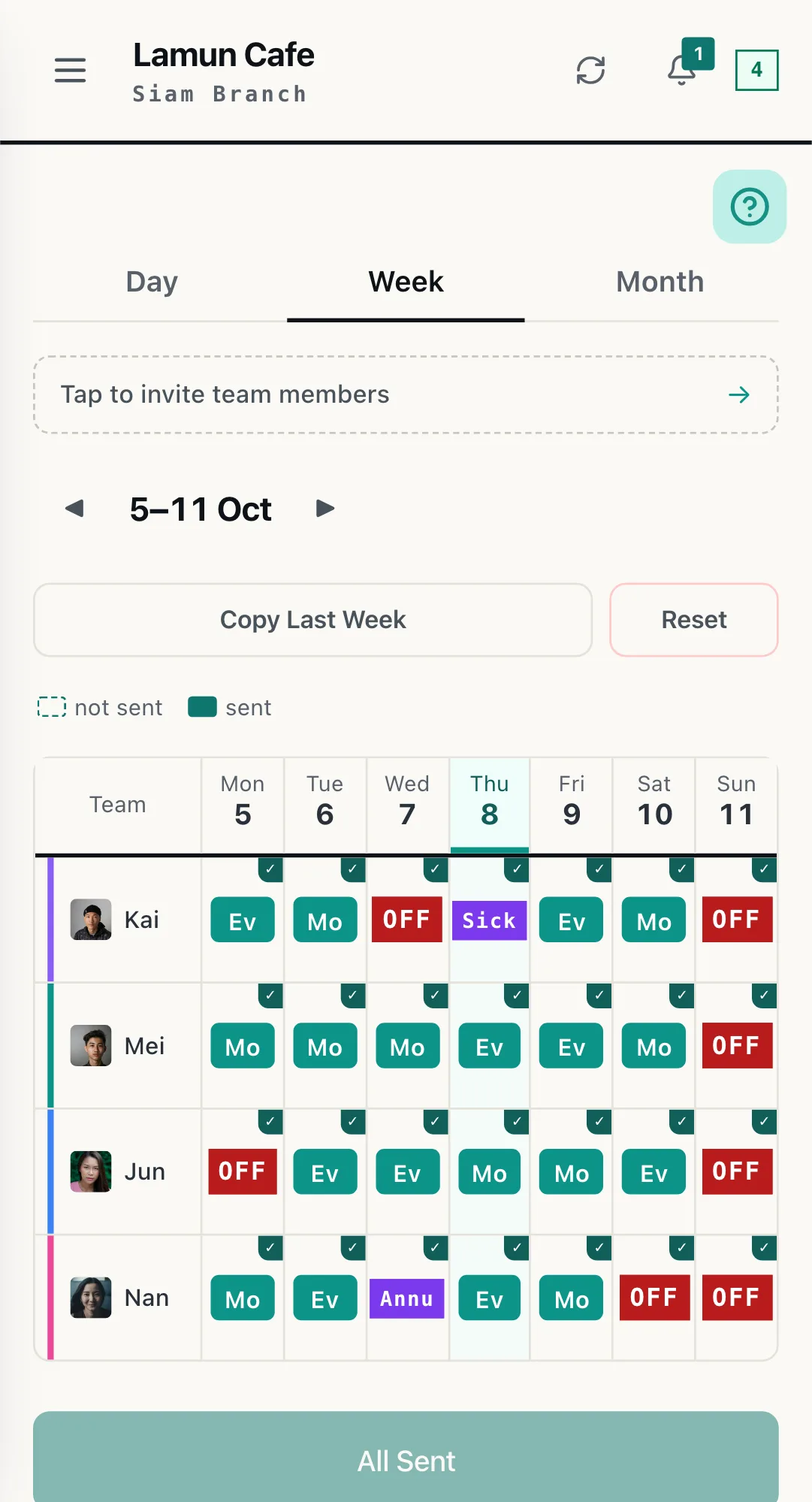
THE REAL SCREEN · SCHEDULE
In place of the Excel file and the group chat, the whole week sits in one grid. Copy last week, then send once.
WorkCo is free forever for small teams. Bigger teams get 60 days free, with every feature. Start free.
9. Frequently asked questions
Which day is the regular day off?
Any day the employer and worker agree on. Article 36 requires one in every 7-day cycle but names no weekday, and the Ministry of Labor confirms it need not be Saturday or Sunday. Write it into the work rules or contract.
How is pay worked out for work on a regular day off?
Work on a 例假 is allowed solely under Article 40: a natural disaster, accident or emergency. The wage is doubled, meaning one extra day's wage on top of the normal pay, and a day of rest follows. Without an Article 40 reason, the double wage is still owed and the employer can be fined.
Is a regular day off the same as a national holiday?
No. A national holiday (國定假日, Article 37) may be worked with the worker's consent, at double pay (Article 39). A 例假 may not be worked even with consent, except under Article 40.
A worker asks to work on their regular day off. Is that allowed?
No. The Ministry of Labor says that without an Article 40 reason, the employer may not have a worker work on a 例假, even with the worker's consent. Offer the rest day (休息日) instead, with consent and rest-day pay, or swap the day off by agreement while keeping to no more than 6 working days in a row.
How many regular days off are there in a month?
One in every 7-day cycle. A 28-day stretch holds 4; a month of 30 or 31 days holds 4 or 5, depending on where the cycles fall, because the cycle does not restart on the 1st. Flexible working hours follow the Article 36(2) minimums.

Count your roster against the 7-day cycle this week. Then add us on LINE and talk to a real person on our team.