The Floor · Thailand
Hidden costs · 2026
The True Cost of Manual Scheduling for Thai SMBs
It is 11:00 PM on a Sunday. Instead of resting for the week ahead, you are hunched over a phone, scrolling through a chaotic LINE group chat. For owners in F&B, retail, and clinical services, manual scheduling feels "free." In reality, it is a massive hidden tax on your growth.
1. Introduction: The Invisible Drain on Your Business
It is 11:00 PM on a Sunday. Instead of resting for the week ahead, you are hunched over a phone, scrolling through a chaotic LINE group chat. You see that ten staff members have "read" the new schedule, yet only two have confirmed. One is privately messaging you about a shift swap for tomorrow morning, while another just sent a sticker that buried the roster you posted five minutes ago.
As a business owner who spent years managing shifts manually, I see this scenario daily. For owners in F&B, retail, and clinical services, manual scheduling feels "free" because you aren't paying for a subscription. In reality, it is a massive hidden tax on your growth. The frustration of messages being "read" but ignored isn't just a digital nuisance -it's an operational failure that drains your time, money, and mental energy.
2. The Time Thief: Analyzing the 2.3-Hour Gap
Data from the Bangkok SMB market shows that manual scheduling is a relentless "time thief." The average Thai manager spends 2.3 hours per week managing shifts. Over a year, this totals more than 100 hours of lost productivity.
For a manager, this time is consumed by:
- Building the initial shift roster in Excel or on paper.
- The "LINE shuffle": Communicating changes and chasing confirmations across fragmented chats.
- Handling the 89% of managers who report that last-minute shift changes are their single biggest headache.
In the F&B sector, this burden is even heavier. High-pressure environments and the 94% of F&B managers who report "weekend and holiday chaos" see their scheduling time swell to 3.1 hours per week.
3. Quantifying the Opportunity Cost
As a business owner, you must view your time through the lens of opportunity cost. At a standard manager's rate of 300 THB/hour, the 2.3 hours spent on manual scheduling creates a 33,120 THB per year "manual tax."
Contrast this with a dedicated solution like WorkCo, which is free for your first 60 days, with every feature open and any number of staff: scheduling, check-in and leave included. Choosing to stay manual is effectively choosing to lose thousands of baht in productivity. This isn't just an internal problem; scheduling inefficiency results in 2.8 billion THB in lost productivity annually across Bangkok alone.
Market research shows that 67% of managers are already willing to pay a 20-30% premium specifically for a tool that integrates with LINE. They recognize that the "free" method is actually the most expensive way to run a business.
4. The Communication Breakdown: No-Shows and Buried Messages
Currently, 48% of Thai businesses use LINE or WhatsApp groups for scheduling. However, these managers give this method a satisfaction score of only 3.2/10.
The reason is structural. In a standard LINE group, critical shift information is constantly buried under casual chat and stickers. This lack of structure is a direct driver of the 71% no-show rate reported by managers. When an employee misses a shift because they "didn't see the message," the financial damage escalates:
- Finding a last-minute replacement takes an average of 1.8 hours.
- The resulting operational friction and lost labor cost your business approximately 3,200 THB per month.
5. The Compliance and Payroll Trap
Manual scheduling also exposes you to significant risk under the Labor Protection Act. Data shows that 67% of managers struggle with manual payroll preparation, while 58% find tracking overtime error-prone without dedicated tools.
In Thailand, the common bi-monthly payroll cycle (the 1st to 15th and 16th to end of month split) creates a recurring 2.1-hour weekly burden for managers trying to reconcile manual hours. Without a structured system, it is easy to violate mandatory requirements:
- Mandatory Rest: At least 1 day off per week.
- Work Hours: Maximum 8 hours per day or 48 hours per week.
- Overtime Premiums: 1.5x for regular OT and 3x for holiday work.
Furthermore, the law requires employers to keep attendance records for at least 2 years. Managing this on paper or in deleted LINE chats is a compliance time bomb.
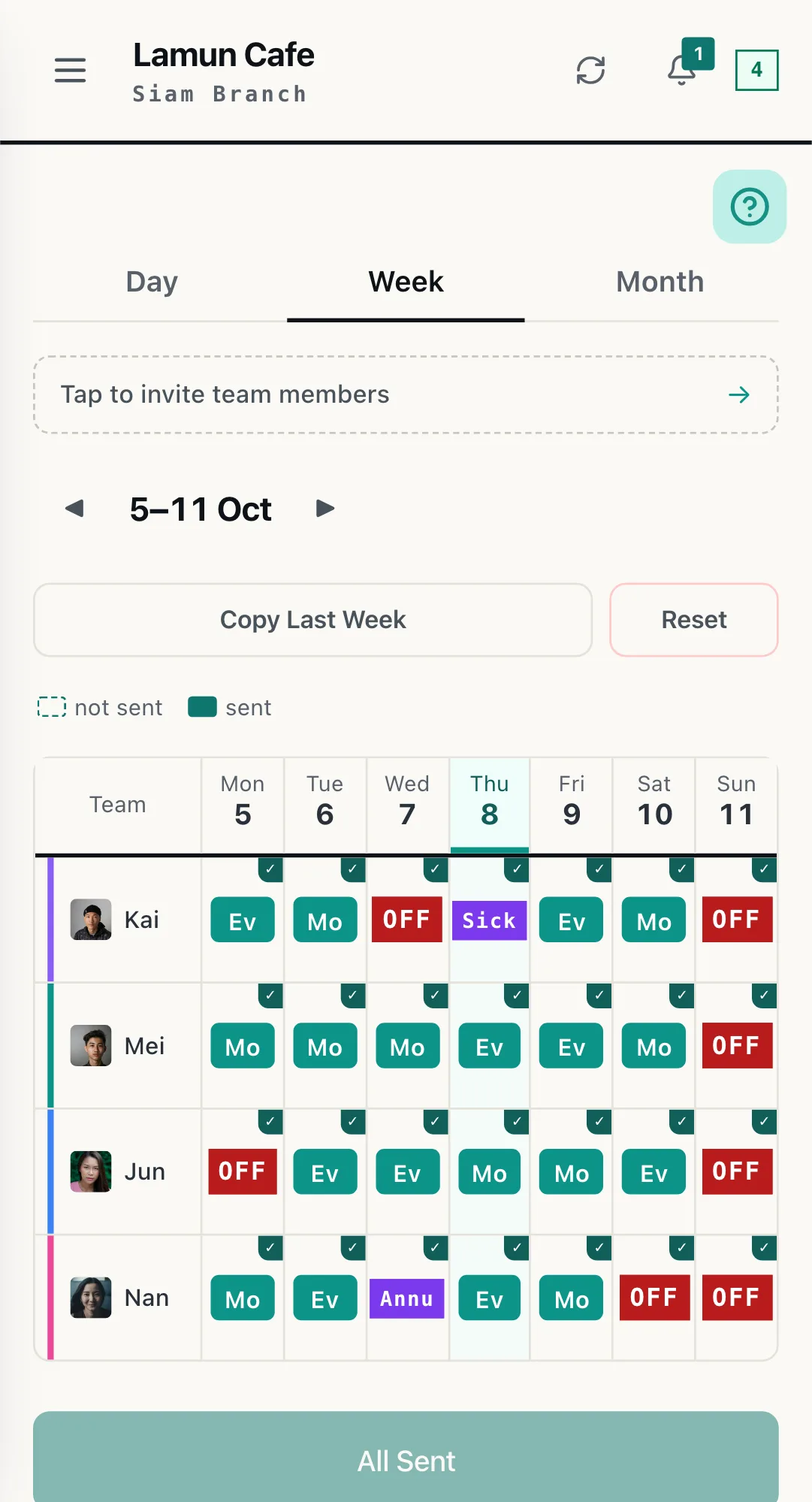
THE REAL SCREEN · SCHEDULE
In place of the Excel file and the group chat, the whole week sits in one grid. Copy last week, then send once.
6. Practical Tips for Thai Business Owners
To reclaim your time and protect your business, I recommend four actionable steps:
- Stop Using Static Documents: Excel and paper cannot update in real-time. This leads to version conflicts where staff look at an old schedule while you are looking at the new one.
- Centralize Your Communication: Move shift assignments out of general chat groups. When schedules are mixed with stickers and social talk, they lose their authority.
- Audit Your Admin Time: For one month, track exactly how many minutes you spend fixing rosters, calling for replacements, and calculating bi-monthly payroll. The total cost will likely shock you.
- Adopt LINE-Native Tools: Since 94% of Thai workers use LINE daily, do not force them to download a new, foreign app. Use a tool that lives inside LINE to ensure zero friction adoption. You aren't asking them to learn a new app; you are giving them a better version of the one they already check 20 times a day.
7. Conclusion: Reclaiming Your Growth Time
Reclaiming 2.3 hours a week isn't just about finishing work earlier. It's about finding 100+ hours a year to focus on menu innovation, staff training, or opening your next branch.
Stop paying the "manual tax" today. Move your schedule to where your employees already are. WorkCo is a LINE-native scheduling solution built specifically for the Thai market. It offers a zero-download, zero-friction experience: you tap to assign, and your staff receives their schedule directly in their LINE chat.
By choosing a system built for the way Thai businesses actually operate, you can eliminate the chaos and focus on your future growth.
Stop the manual drain. Start your growth. Discover WorkCo today.
8. Frequently asked questions
How much time do Thai managers lose to manual scheduling?
Count it for your own shop: add the hours each week spent building the roster, changing it when someone is sick or swaps, and checking hours at month end, then multiply by 52. That is what your current roster really costs you in a year.
What is the hidden cost of free manual scheduling?
Multiply those hours by what an hour of a manager's time is worth. As an example, 3 hours a week at 300 baht an hour is 3 × 300 × 52 = 46,800 baht a year. Then add the shifts run short because a change did not reach someone, and pay mistakes from working it out by hand.
Why do staff miss shifts when scheduled through LINE groups?
In a LINE group the roster is one message among many. A change posted at night is buried under chat and stickers by morning, so someone comes in on the old shift or not at all. The fix is that each person gets their own shifts, and a change reaches only the people it affects.
How does manual scheduling create labour law risk in Thailand?
A hand-made roster makes it easy to break the Labour Protection Act: at most 8 hours a day and 48 a week (section 23), at least 1 weekly rest day, no more than 6 days apart (section 28), overtime at 1.5x on a working day (section 61), work on a holiday at 1x extra or 2x depending on how the person is paid (section 62), and overtime on a holiday at 3x (section 63). Pay records, including days and hours worked, must be kept for at least 2 years (sections 114-115).
How does a LINE-native tool fix manual scheduling for Thai SMBs?
Staff already have LINE, so there is nothing to download and no new account. WorkCo runs inside LINE for the schedule, check-in and leave: the owner copies last week, changes only what is different and sends once, and each person gets their own shifts in their own LINE.
Stop the manual tax. Reclaim the hours. Spend them on growth. That is what WorkCo was built for.

Stop the manual drain today. Scheduling, check-in and leave included, and no downloads for your team.