SCHEDULING · 2026
Staff shift schedules in Thailand: 6-on-1-off, 5-on-2-off and the law
In Thailand, a legal staff shift schedule keeps normal hours to 8 a day and 48 a week, gives a break of at least 1 hour before 5 hours of continuous work, and gives at least one weekly rest day, with rest days no more than 6 days apart (Labour Protection Act, sections 23, 27 and 28). So both 6-on-1-off and 5-on-2-off are legal, as long as no day has more than 8 normal hours and no rest day drifts more than 6 days from the last one. Below: a worked 6-on-1-off week, holiday pay rates, a checklist and a free template that opens in Excel.
1. What a staff shift schedule needs
A shift schedule is a notice of working time. Section 23 asks the employer to announce normal working hours, with a start and an end time for each day. A good schedule answers at a glance: who works, where, on which day, from when to when, when they break and which day they rest.
| Column | Why it is there |
|---|---|
| Name (one row per person) | Each person finds their own line |
| Role | Check each shift has the roles it needs |
| Location | Nobody is booked at two branches at once |
| Date and weekday | Rest days are counted by real dates (section 28) |
| Shift start and end | Normal hours at most 8 a day, 48 a week (section 23) |
| Break | At least 1 hour, before 5 hours of work (section 27) |
| Rest day | At least 1 a week, at most 6 days apart (section 28) |
| Weekly hours | Shows at once who is over 48 (breaks not counted) |
Let one person approve the schedule: the owner or the branch manager. The version sent is the one in force, and a change goes straight to the person it affects. Keep every week's version: it is your record when a pay question comes up.
2. Common shift patterns and the law check for each
| Pattern | How it works | Law check |
|---|---|---|
| 6-on-1-off (rotating rest day) | Work 6 days, rest 1. Each person rests on a different day, so the shop opens all 7 days. | 6 x 8 = 48 hours, exactly the section 23 ceiling. Any hour above it is overtime and needs consent (section 24). The rest day can be any agreed day, at most 6 days from the last one (section 28). |
| 5-on-2-off | Work 5 days, rest 2: the weekend, or two days together mid-week. | 5 x 8 = 40 hours, under the 48 ceiling. The legal minimum is one rest day (section 28); the second is the shop's own terms. Plan any day over 8 hours as overtime. |
| Two shifts, morning and evening | For example 09:00-18:00 and 13:00-22:00, overlapping in the busy afternoon. | A 9-hour shift with a 1-hour break is 8 working hours. The break starts before 5 hours of work (section 27): morning shift at 13:00, evening shift at 17:00. |
| Three shifts, 24 hours | For example 07:00-15:00, 15:00-23:00 and 23:00-07:00. | An 8-hour shift with a 1-hour break is 7 working hours. Work that must run without a stop may skip the break with the employee's consent, or in an emergency (section 27). Work hazardous to health is capped at 7 hours a day and 42 hours a week (section 23). |
| Split shift | For example 10:00-14:00 and 17:00-21:00: 8 working hours with a 3-hour gap. | Breaks over 2 hours a day count as working time for the part above 2 hours (section 27). Food and drink shops that open in separate periods each day may have breaks over 2 hours, per the Ministry of Labour's rights summary. |
3. A worked 6-on-1-off schedule for a shop open 7 days
This is a worked example for an imagined shop: 6 staff, open 09:00-22:00 every day. Morning shift 09:00-18:00 (break 13:00-14:00), evening shift 13:00-22:00 (break 17:00-18:00), 8 working hours each. Everyone rests on a different day, so Sunday, the busiest day, has all 6 people.
| Staff | Mon | Tue | Wed | Thu | Fri | Sat | Sun | Hours/week |
|---|---|---|---|---|---|---|---|---|
| Staff 1 | Off | AM | AM | AM | AM | AM | AM | 48 |
| Staff 2 | PM | Off | PM | PM | PM | PM | PM | 48 |
| Staff 3 | AM | AM | Off | AM | AM | AM | AM | 48 |
| Staff 4 | PM | PM | PM | Off | PM | PM | PM | 48 |
| Staff 5 | AM | AM | AM | AM | Off | AM | AM | 48 |
| Staff 6 | PM | PM | PM | PM | PM | Off | PM | 48 |
| Staff per shift, AM / PM | 2 / 3 | 3 / 2 | 2 / 3 | 3 / 2 | 2 / 3 | 3 / 2 | 3 / 3 |
Check every row against the law:
- Rest day: everyone has 1 rest day this week. If next week keeps the same day, nobody works more than 6 days in a row: section 28 is met.
- Hours: 6 days x 8 hours = 48, exactly the section 23 ceiling. One extra hour for anyone is overtime.
- Break: both shifts break after 4 hours of work, inside the 5 hours of section 27.
The common mistake is moving a rest day between weeks. Say Staff 1 rests on Monday, and next week the rest day moves to Wednesday. They now work Tuesday through the next Tuesday: 8 days in a row, over the 6 days of section 28. Moving a rest day earlier in the week is always safe. To move it later, add one extra rest day that week, so nobody works more than 6 days in a row.
If the week has a traditional holiday (section 29), decide beforehand who works it, and pay holiday rates as in part 5 below.
4. Can staff work 7 days in a row?
As a plan, no. Section 28 requires at least one weekly rest day a week, with rest days no more than 6 days apart. So every schedule shows a rest day for every person.
- Saving up rest days: hotel work, transport, forestry, work in remote areas, or other work named by ministerial regulation may agree in advance to save rest days and take them later, within 4 consecutive weeks (section 28). Shops and restaurants are not on this list.
- Working a rest day now and then: section 25 lets hotels, entertainment venues, transport, food shops, drink shops, clubs, associations and medical facilities have staff work on a holiday. Other businesses need consent each time. That day is paid at holiday rates and counts toward the 36-hour weekly cap.
- If the rest day is not given: section 64 says that when the employer does not give the rest days of sections 28 to 30, it pays holiday-work and holiday-overtime rates, as if the staff had worked on a holiday.
5. What to pay for work on a holiday
Every rate is a multiple of the hourly rate on a working day, and every rate is a minimum. For monthly-paid staff, the hourly rate = monthly wage ÷ (30 x normal hours a day), section 68.
| Case | Minimum rate | Who it applies to |
|---|---|---|
| Overtime on a working day | 1.5x per hour (section 61) | All staff. Needs consent each time (section 24). |
| Holiday work in normal hours, staff already paid for that holiday | At least 1x extra (section 62) | Monthly staff on their weekly rest day, and all staff on a traditional holiday or annual leave day (section 56) |
| Holiday work in normal hours, staff not paid for that holiday | At least 2x (section 62) | Daily, hourly and piece-rate staff on their weekly rest day (section 56) |
| Overtime on a holiday | 3x per hour (section 63) | All staff |
| Combined cap | Overtime plus holiday work: at most 36 hours a week | Section 26 and Ministerial Regulation No. 3 (1998) |
A worked example: a daily-paid staff member works 8 hours on their weekly rest day. They get at least 2x the hourly rate for those 8 hours, and 3x for any overtime after. The full method and a calculator are in working hours and overtime in Thailand.
6. Free shift schedule template for Excel
Download the 7-day staff shift template (shift-table-th.csv) for free. It is a CSV file in Thai that opens straight in Excel, or in Google Sheets through File > Import.
- Columns for name, role and location, then Monday to Sunday, with a row for the dates.
- The 6-person 6-on-1-off example from part 3, with cells like 09:00-18:00 or "หยุด" (off).
- A weekly hours column to fill in (48 or under), and notes on sections 23, 27 and 28 at the bottom.
7. Six checks before you send the schedule
- Everyone has at least 1 rest day this week, and counting from last week, nobody works more than 6 days in a row (section 28).
- Normal hours at most 8 a day and 48 a week; 7 and 42 for hazardous work (section 23).
- Every shift has a break of at least 1 hour that starts before 5 hours of work, and a break of at least 20 minutes before overtime of 2 hours or more (section 27).
- Overtime and holiday work are agreed, and together stay at 36 hours a week or under (section 24 and Ministerial Regulation No. 3).
- If the week has a traditional holiday, you know who works it and at which rate (sections 29 and 62).
- Every shift has the roles it needs, and every person has received their own shifts, not a picture of the grid in a group chat.
8. From Excel to LINE
Excel is a good start. But the sending usually ends as a screenshot in a LINE group, and a mid-week change gets lost in the chat. WorkCo runs inside the LINE your team already uses:
- Build the week by tapping a shift onto each person, and use Copy Last Week when next week looks the same.
- You can also do this on a computer: WorkCo opens in any web browser, signed in with LINE, and on a wide screen the menu stays open on the left.
- Each person gets their own shifts in their own LINE. When a shift changes, it is sent to them again.
- Daily, weekly and monthly views; several locations, roles and shift types; split shifts are an owner setting.
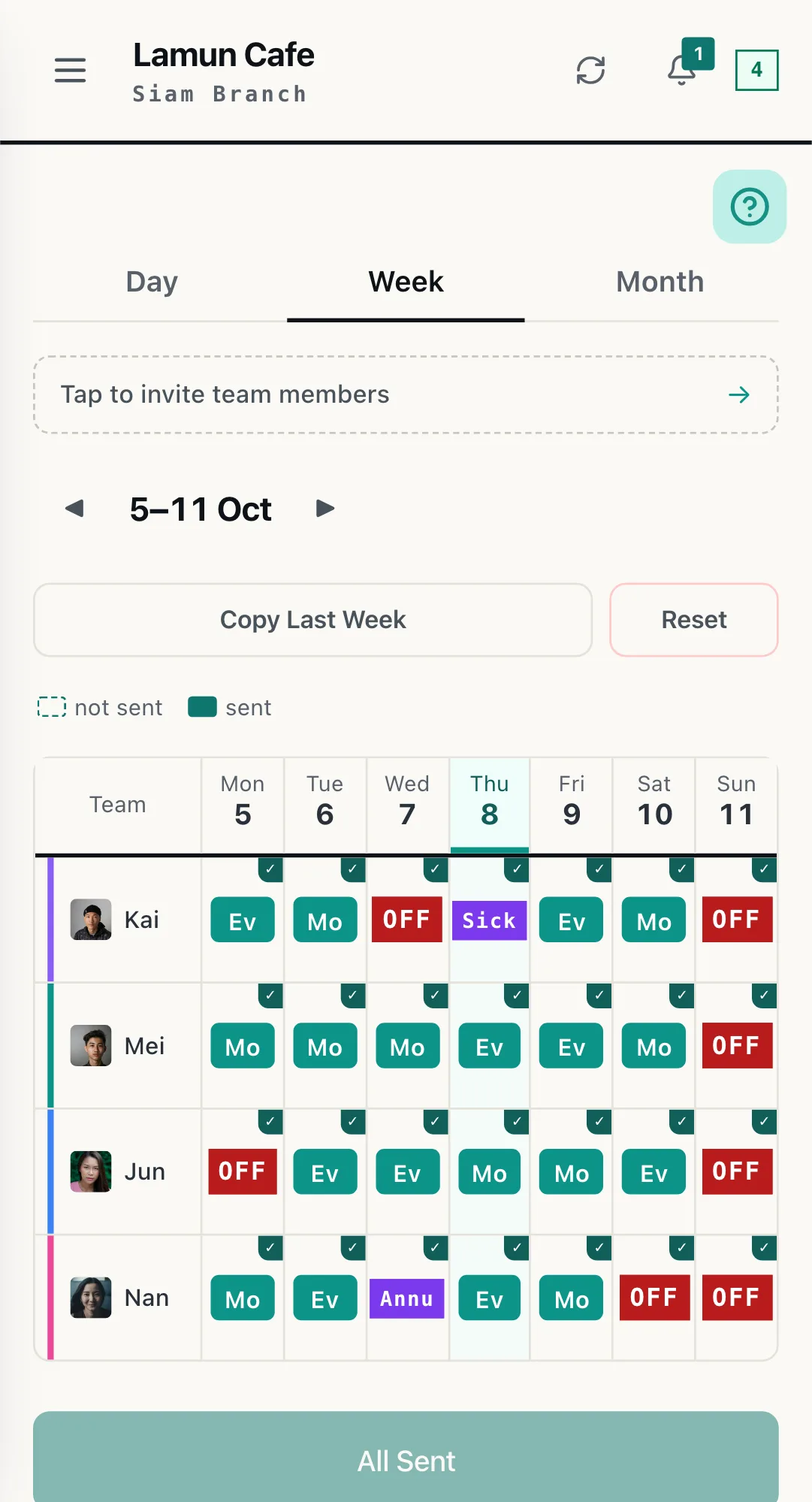
THE REAL SCREEN · SCHEDULE
In place of the Excel file and the group chat, the whole week sits in one grid. Copy last week, then send once.
Step by step: the schedule guide. For shift teams: shift work scheduling. For restaurants: restaurant scheduling. Sick leave: sick leave in Thailand.
WorkCo is free forever for small teams. Bigger teams get 60 days free, every feature. Start free.
This is a summary of the law, not legal advice. Sources: Labour Protection Act B.E. 2541, sections 23-29, 56, 61-64 and 68; Ministerial Regulation No. 3 (1998); the Ministry of Labour's summary of employer and employee rights. Checked on 23 November 2026.
9. Frequently asked questions
Is a 6-on-1-off schedule legal in Thailand?
Yes. Section 28 requires at least one weekly rest day, and 6 days x 8 hours = 48 hours, exactly the section 23 ceiling. Any hour above that is overtime: it needs consent and pays at least 1.5x. When rest days rotate, nobody should work more than 6 days in a row.
Does the weekly rest day have to be Sunday?
No. Under section 28, employer and employee may agree in advance on any day. Each person can rest on a different day, as long as rest days are no more than 6 days apart.
Can a shift be 12 hours long?
Yes, as normal hours plus overtime. A 12-hour shift is 8 normal hours (section 23), a 1-hour break and overtime for the rest. Overtime needs consent each time (section 24), pays at least 1.5x (section 61), and overtime plus holiday work stays at 36 hours a week or under (Ministerial Regulation No. 3). Overtime of 2 hours or more needs a 20-minute break before it (section 27).
How long must the break be?
At least 1 hour a day, starting before 5 hours of continuous work (section 27). By advance agreement it can be split into shorter breaks that add up to at least 1 hour. Overtime of 2 hours or more after a shift needs a 20-minute break first.
Is Excel good for a shift schedule?
For one shop with stable shifts, yes: start with the free template in this post. Excel does not send each person their own shifts or tell them about a change, and it does not check rest-day gaps unless you build the formula.
How do I send the schedule on LINE so nobody misses a shift?
Send each person their own shifts, in place of a picture of the grid in the group, before the week starts. When something changes, tell the person affected what changed. WorkCo sends each person their shifts in their own LINE, and again when a shift changes.

Send next week's schedule into each person's LINE. Add us on LINE and talk to a real person on our team.