The Floor · Industry
Industry perspective
Frontline adoption beats features: the only tool that survives is the one you never have to talk them into
Most workforce software does not die because a feature is missing. It dies because nobody uses it. The manager chooses it and starts using it, the frontline never starts, and the tool quietly fades away inside a group chat. This is about the real reason that happens, and why the next decade will be decided on the absence of friction rather than the length of a feature list.
1. Most tools fail at adoption, not at features
Almost all workplace tools are bought on a feature list and judged in a demo by a manager who is already comfortable with software. The people who have to use it every day, the frontline, were never in the room. So the tool wins the demo and then loses the shift.
The root of this is the gap between who chooses a tool and who has to use it. The person who chooses is the manager. The people who have to use it every day are the frontline. They are not the same group. So the tool gets judged on what impresses the chooser, but lives or dies on what the users will actually do. Adoption is not a secondary number you check later. It is the single measure of whether the tool lives or dies.
2. How it actually dies: quietly, in a group chat
The scene repeats itself again and again. A company buys a system. The manager sets it up, invites the team, and drops a download link into the group chat. Some staff install it, some do not. Of those who install it, some stall at the sign-up, some forget the password. Two weeks later, somebody asks about a shift in the group chat, and gets an answer in the group chat. The system that was just bought becomes a place only the manager ever opens.
The group chat does not win because it is better. It wins because it has no steps to cross. Everyone is already inside it. Nothing to download, no account to create, no new gesture to learn. Any new tool that genuinely wants to replace it has to have none of those steps either.
The frontline does not choose the group chat because they love it. They choose it because it asks nothing more of them.
3. The behaviour-change test
There is one question that predicts, fairly accurately, whether a tool will actually get used. Ask it of every part of the tool: does the frontline have to change what they already do in order to use this? Every yes is a place where adoption leaks out.
A new app to download is one yes. A new account to sign up for is another. A new screen you have to remember to check is another. A password to remember is another. Each one sounds small on its own, but stacked together they form a wall most of the team never gets over. The tools that survive are the ones with the fewest yeses, ideally none.
4. Why living inside the messaging app already in use wins
If the goal is to cut the yeses to as close to zero as possible, the most direct answer is this: do not build a new place for staff to go, go to the place they are already in. That is the messaging app they open dozens of times a day. A tool delivered there needs no download, no password and no new habit.
Once the download and the login are gone, the number of yeses from the earlier test collapses to almost none: no account to sign up for, no password to remember, no new place to go. All that is left is tapping a message that arrives like every other message in the day. With no steps to leak through, adoption is not something you have to win. It arrives with the very first message.
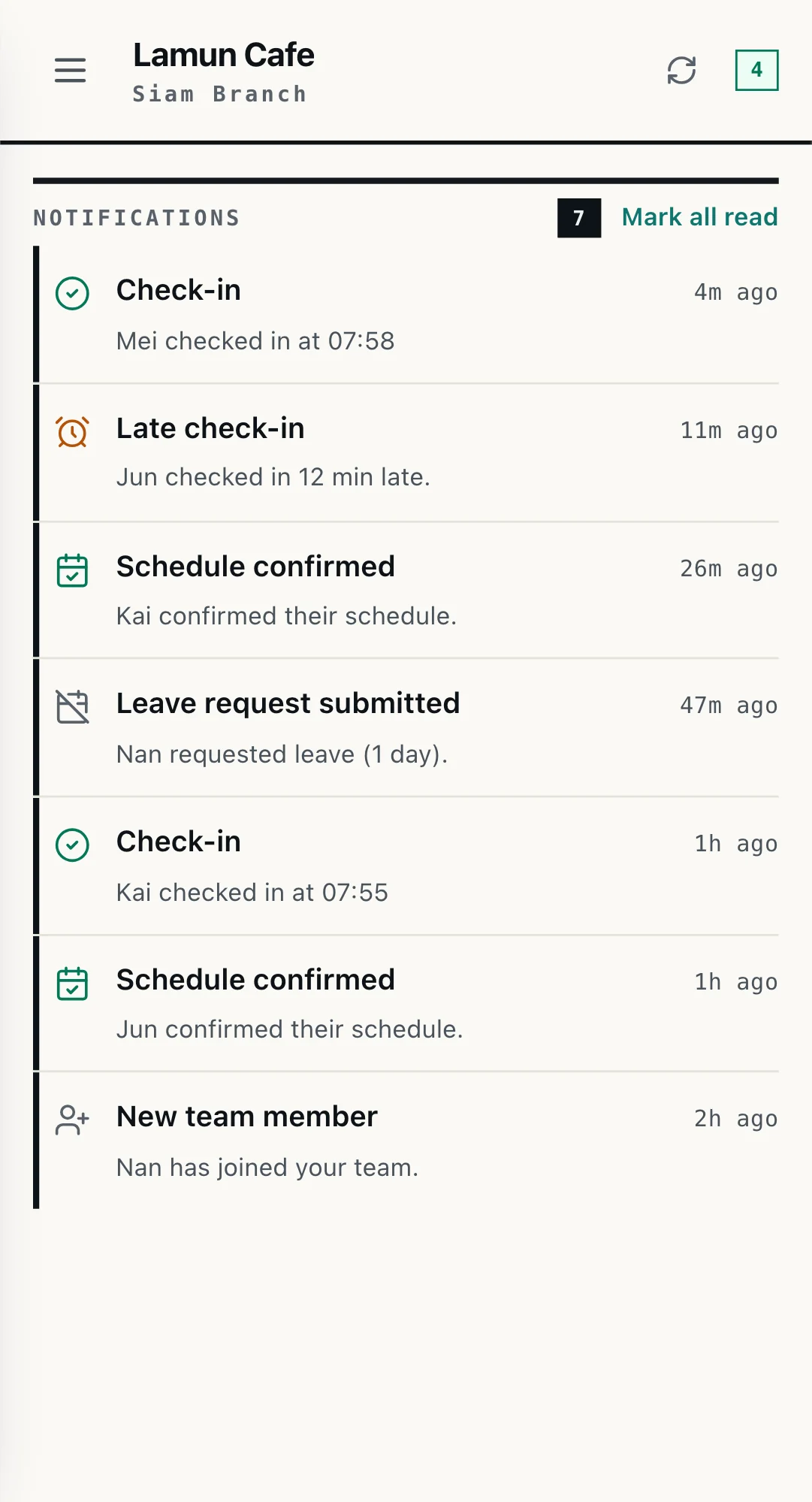
THE REAL SCREEN · NOTIFICATIONS
Adoption happens by itself when the tool lives in an app that is already open. Open a message, tap a button, done. No new gesture to remember.
5. The next decade is won on the absence of friction
Adding features hit the point of diminishing returns long ago. Most tools in this category can do almost all of the same things. What still genuinely differs is how many people on a team use it on an ordinary Tuesday with nobody having to remind them. That means the field is shifting from counting features to counting the steps you can take away.
WorkCo is one example of a tool with almost nothing to adopt. We deliberately do one thing, the schedule, and bring it to teams in Thailand right inside the LINE they already have open every day. Run the test against it: no app to download, no account to sign up for, no password to remember. Almost every answer is a no. That is why nobody has to be chased into using it. There is no step left for anyone to drop through.
Frequently asked questions
Why do frontline staff not adopt workforce apps?
Because most workforce apps ask the frontline to change what they already do: download a new app, create an account, remember a password, open it during a busy shift. Each of those steps loses people. The manager adopts the tool, the staff never do, and the team quietly falls back to the group chat it was already using.
What is adoption friction?
Adoption friction is every step a tool asks a worker to take before it becomes useful: a download, a sign-up, a password, a new screen, a new habit. On the frontline, where people are busy and on their feet, each step quietly removes a share of the team. Friction is what kills adoption long before a missing feature ever does.
Why does workforce software fail at adoption rather than features?
Because most tools are bought on their feature list and judged in a demo by a manager who is comfortable with software. The staff who have to use it every day were never in the room. So the tool wins the demo, then loses the shift. It does not fail because a feature is missing. It fails because the frontline was asked to change, and did not.
What is the behaviour-change test for workforce tools?
Ask one question of every part of the tool: does the frontline have to change what they already do to use this? Every yes is a place adoption leaks. A new app is a yes. A new account is a yes. A new screen to check is a yes. The tools that survive are the ones with almost no yeses, because they live where the team already is.
Why does living inside a messaging app win?
Because it removes the two steps that lose the most people at once: the download and the login. Run the test against it and the number of yeses collapses to almost none. No account to sign up for, no password to remember, no new place to go. All that is left is tapping a message that arrives like any other. So adoption is not something you have to win. It arrives with the first message.
Want to see a tool you never have to talk your team into?
WorkCo is scheduling delivered straight into the LINE your team already has open. Nothing to push through, no launch day, no training session. Staff just tap a message and they are using it. Free up to 15 staff.