The Floor · Thailand
Thai Labor Law · 2026
Working Hours in Thailand (2026): Overtime Pay, Rest Days and Public Holidays
If you run a restaurant, hotel, clinic, shop or factory in Thailand, whether you are Thai or a foreign owner, these are the working-time rules your schedule has to follow: hours, rest days, Saturdays, public holidays, overtime pay and records. The short answer comes first, then the detail, a 2026 holiday list and an overtime calculator.
1. The Hidden Costs and Legal Risks You May Have Never Calculated
For managers running restaurants, clinics, or service businesses in Bangkok, shift management is not just a daily headache - it is a matter of legal risk and financial loss. Market research shows that SME managers in Bangkok spend an average of 2.3 hours per week on scheduling alone, representing a productivity loss valued at 33,120 baht per year.
Beyond the time cost, 58% of managers struggle to track overtime (OT) accurately. Manual systems like paper or Excel are not only error-prone -they create compliance risk, the danger of unintentionally violating labor law. This can lead to heavy fines and severe disputes. This article summarizes the fundamental legal requirements you need to know to protect your business.
2. Core Requirements: Working Hours & Holidays
To keep your business compliant with the Labor Protection Act, employers must adhere to the following standards:
- Standard working hours: Must not exceed 8 hours per day, with a weekly total of no more than 48 hours.
- Weekly rest day: Employees must have at least 1 rest day per week. They cannot be required to work more than 6 consecutive days.
- Traditional holidays: Employers must announce at least 13 holidays a year in advance, including National Labour Day, chosen with regard to official, religious and local holidays. If one falls on a weekly rest day, the next working day is given off instead.
- Saturday: The law does not require Saturdays off. Six 8-hour days (48 hours) is legal; which day is the rest day depends on the work rules and the contract.
- Breaks: At least 1 hour after no more than 5 consecutive hours of work. Breaks do not count as working time.
- Leave: At least 6 working days of annual leave after 1 year. Sick leave for the actual illness, paid for up to 30 working days a year.
Scheduling that violates these rules not only affects employee health and performance - it is also the first thing labor inspectors look for when auditing your establishment.
Thailand public holidays 2026
This is the Bank of Thailand's 2026 holiday list. A private employer announces at least 13 holidays of its own, and most choose them from this list. Khao Phansa (Thu 30 Jul) is a government holiday but not a bank holiday.
| Date | Holiday |
|---|---|
| Thu 1 Jan | New Year's Day |
| Fri 2 Jan | Special holiday (cabinet) |
| Tue 3 Mar | Makha Bucha |
| Mon 6 Apr | Chakri Memorial Day |
| Mon 13 Apr | Songkran |
| Tue 14 Apr | Songkran |
| Wed 15 Apr | Songkran |
| Fri 1 May | National Labour Day |
| Mon 4 May | Coronation Day |
| Mon 1 Jun | Visakha Bucha, moved from Sun 31 May |
| Wed 3 Jun | Queen Suthida's Birthday |
| Tue 28 Jul | King's Birthday |
| Wed 29 Jul | Asarnha Bucha |
| Wed 12 Aug | Mother's Day (Queen Mother's Birthday) |
| Tue 13 Oct | King Bhumibol Memorial Day |
| Fri 23 Oct | Chulalongkorn Day |
| Mon 7 Dec | Father's Day, moved from Sat 5 Dec |
| Thu 10 Dec | Constitution Day |
| Thu 31 Dec | New Year's Eve |
Source: Bank of Thailand Notification No. 31/2568, financial institution holidays for 2026.
3. Deep Dive: Overtime (OT) & Holiday Work Pay Rates
Confusion over pay rates is the leading cause of labor disputes. Employers must calculate compensation based on the type of work and the employee's pay structure as follows:
| Type of Work | Pay Rate (vs. regular rate) | Notes for SMEs |
|---|---|---|
| Overtime on regular workdays | 1.5x | Calculated for hours worked beyond standard working hours |
| Working on holidays (regular hours) | 1x (monthly) / 2x (daily) | Monthly-salaried employees are considered already paid for holidays |
| Overtime on holidays | 3x | For hours exceeding standard working hours on a holiday |
Important Warning: Overtime and holiday work require the employee's consent on each occasion. Forcing employees to work without documented consent is a serious legal liability.
Thai overtime calculator
Enter the wage and one week's hours to see the legal minimum to pay.
4. Record-Keeping Obligations: Why Manual Systems Are Dangerous
The law explicitly requires employers to maintain employee registers and attendance records. The critical mandate: "Attendance records and payment documents must be retained for at least 2 years."
Today, many SMEs still rely on inefficient methods that lead to serious problems:
- LINE Groups (satisfaction: 3.2/10): Schedule information gets "buried" in conversation threads, causing employees to miss critical updates - resulting in a 71% no-show problem rate.
- Paper / Whiteboards (satisfaction: 2.8/10): Prone to loss, impossible to back up, and extremely difficult to retrieve when audited retroactively.
If you cannot produce 2 years of work records when a complaint is filed, your business is immediately at a legal disadvantage.
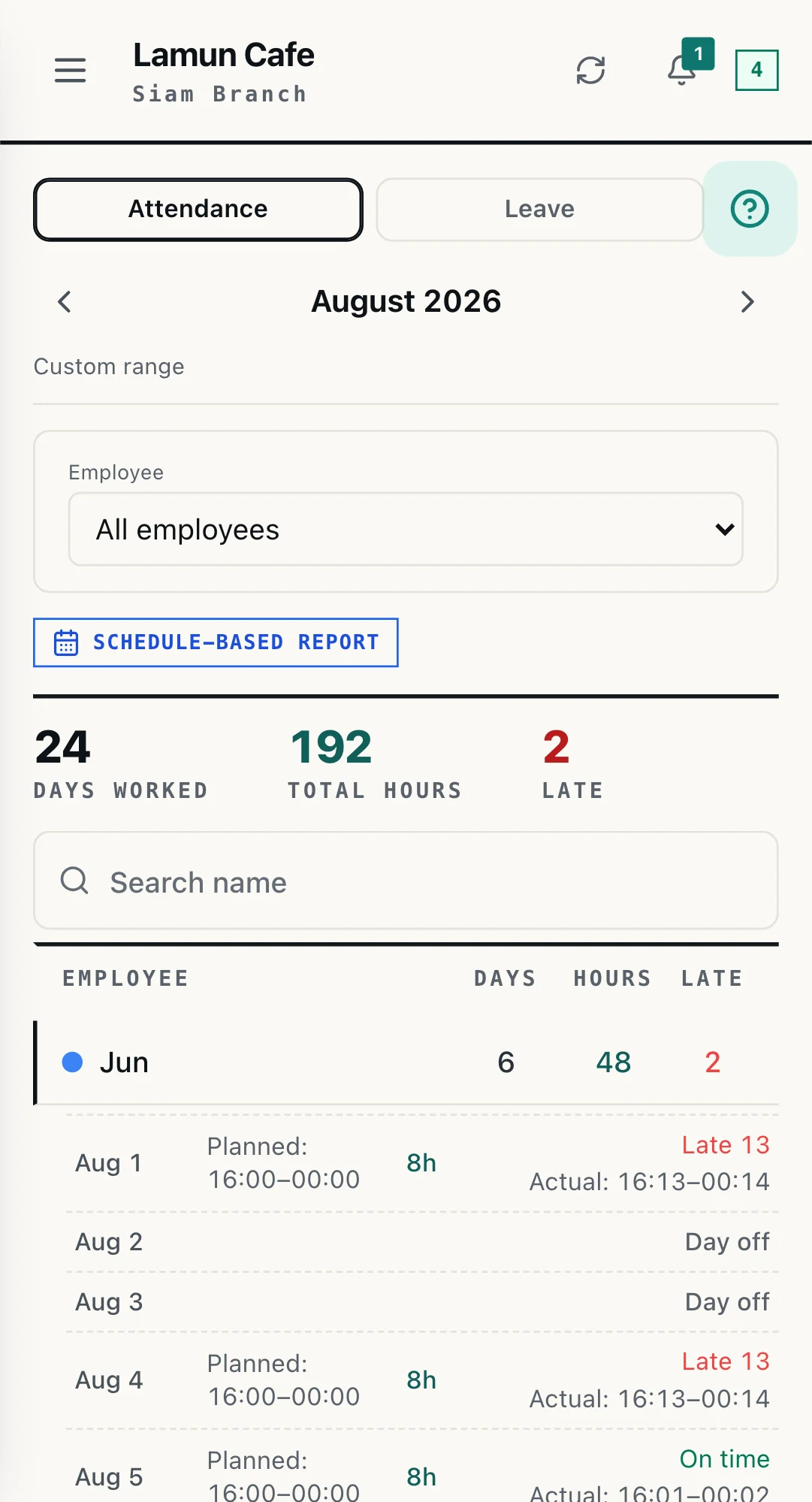
THE REAL SCREEN · ATTENDANCE
Days worked, total hours and late arrivals are recorded from the real check-ins, and can be exported and kept as a file.
5. A Practical Solution: Zero-Friction Adoption with WorkCo
To turn scheduling chaos into a system, WorkCo is a solution designed specifically for the Thai business context - a LINE Mini App that offers advantages foreign tools simply cannot:
- Zero-Friction Adoption (no employee resistance): The biggest problem with management apps is that employees do not want to download yet another app. WorkCo runs inside LINE, which 53 million Thai people already use. "No extra app to download." Employees simply receive schedules and check in through LINE.
- Tap-to-Assign & Instant Delivery: Build schedules in seconds with a tap of your finger, and send personalized schedules directly to each employee's LINE - completely solving the problem of messages getting buried in group chats.
- Features built for Thai law and customs:
- Payroll from the hours actually worked: set Thai-law overtime and holiday rates on each contract with one tap, deduct social security, and pay twice a month (1st-15th and 16th-end of month) if that is how you pay.
- Attendance records: clock-in and clock-out times from real GPS check-ins, late arrivals shown, exportable to CSV or PDF.
- Each person's own language: an owner or manager can use English while staff use Thai, and LINE messages reach each person in the language they chose.
6. Conclusion & Action Steps for Managers
As a manager, getting it right today is always cheaper than fixing problems down the road. Here are three things you need to start doing immediately:
- Audit your working hours: Ensure every employee gets at least 1 rest day per week and works no more than 48 hours per week.
- Pay overtime correctly: Verify your 1.5x and 3x calculations are accurate - especially in service businesses with frequent holiday shifts.
- Ditch the paper system: Switch to digital record-keeping that can be retained for 2+ years and reduce no-show rates.
If you want to cut your 2.3 hours of weekly scheduling time down to just a few minutes and keep your working-time records ready when you need them, WorkCo is the professional assistant ready to transform your business operations through LINE - the app already in your hand.
7. Frequently asked questions
What are the standard working hours under Thai labor law?
Standard working hours must not exceed 8 hours per day, with a weekly total of no more than 48 hours. Employees must have at least 1 rest day per week and cannot be required to work more than 6 consecutive days.
How many public holidays must a Thai employer provide?
At least 13 a year, including National Labour Day on 1 May. The employer announces them in advance, chosen with regard to official, religious and local holidays (section 29). If one falls on a weekly rest day, the next working day is given off instead.
What are the overtime pay rates in Thailand?
Overtime on regular workdays is paid at 1.5x the regular rate. Working on holidays during regular hours is paid at 1x for monthly-salaried employees (who are considered already paid for holidays) or 2x for daily-paid employees. Overtime on holidays is paid at 3x the regular rate. Overtime and holiday work require the employee's consent on each occasion.
How long must Thai employers keep attendance records?
Employers with 10 or more staff must keep pay and working-time documents for at least 2 years from the date of payment, and the employee register for 2 years after each person leaves. If there is a complaint, dispute or lawsuit, keep them until it is finally decided (sections 112-115).
Do overtime and holiday work require employee consent?
Yes. Overtime and holiday work require the employee's consent on each occasion. Forcing employees to work without documented consent is a serious legal liability.
Is Saturday a working day in Thailand?
It can be. Thai law allows up to 8 hours a day and 48 a week, with at least one rest day a week, but does not say which day. A Monday-to-Saturday week is legal as long as it stays within 48 hours. Whether Saturday is a working day depends on the employer's work rules and the employment contract.
What is the maximum overtime per week in Thailand?
36 hours a week, counting overtime on working days and work on holidays together (Ministerial Regulation No. 3). Each occasion needs the employee's consent.
How do you calculate the hourly rate for a monthly-salaried employee?
Divide the monthly wage by 30, then by the normal working hours per day (section 68). For a 15,000 baht salary and 8-hour days: 15,000 ÷ 30 ÷ 8 = 62.50 baht an hour, so one overtime hour on a working day is at least 93.75 baht.
What are the public holidays in Thailand in 2026?
The Bank of Thailand lists 19 holidays for 2026, from New Year's Day on 1 January to New Year's Eve on 31 December, including Songkran on 13-15 April; the full list is in the table above. A private employer announces at least 13 of its own each year.
Can I use WorkCo in English while my staff use Thai?
Yes. Each person picks their own language, and schedules, reminders and leave updates reach each person on LINE in the language they chose. In Thailand the app runs in Thai and English.
Checked against sources on 27 September 2026: the Labour Protection Act B.E. 2541 as amended up to No. 9 (2025), which did not change the sections cited here; Ministerial Regulation No. 3 (1998); Bank of Thailand Notification No. 31/2568; and Wage Committee Announcement No. 14.
This article is general information, not legal advice. Please confirm with a lawyer or labor advisor for your specific situation.
One team, many shifts, all on LINE. That is the business WorkCo was built for.
Want to automate your scheduling and stay compliant? Free up to 15 staff, with scheduling, check-in and leave, and it runs on LINE.