The Floor · Taiwan
LABOUR-LAW BASICS
How leave is counted in Taiwan: annual leave by seniority, sick and personal leave, and what each one pays
The short answer: in Taiwan only one kind of leave depends on seniority, annual leave (特休), from 3 days up to 30, and unused days must be paid out, not wiped. Every other type has a fixed number of days and its own pay rule: sick leave half pay, personal leave unpaid, marriage leave full pay. This article sets them out one by one, with the three mistakes owners make most.
This article is general education, not legal advice. Every business is different. Please rely on the Labour Standards Act and the Ministry of Labor's announcements, and consult a labour-law professional for your own case.
1. Annual leave: the only type that follows seniority
Article 38 of the Labor Standards Act sets annual leave by continuous service, counted from each person's own start date, not from 1 January. The table is:
| Service | Annual leave |
|---|---|
| 6 months to under 1 year | 3 days |
| 1 to under 2 years | 7 days |
| 2 to under 3 years | 10 days |
| 3 to under 5 years | 14 days |
| 5 to under 10 years | 15 days |
| 10 years and up | +1 day per year, up to 30 |
A business chooses how to count the year. The anniversary system (週年制) runs from each person's start-date anniversary and is the simplest. The calendar system (曆年制) runs January to December, and a new hire's first year has to be pro-rated. The Ministry of Labor publishes an official calculator.
2. Unused days are paid out, not wiped
This is where Taiwan differs from many countries. Days left at the end of the year must be paid as wages by the employer; or, by agreement between both sides, carried into the next year once, and paid if still unused after that. On resignation the remaining balance is calculated and paid. So an annual-leave balance is money you owe, not just a number of days.
3. The other types: fixed days, watch the pay
The remaining types do not depend on seniority and do not carry over. Each has its own annual cap and pay status, under the Regulations of Leave-Taking of Workers and the Act of Gender Equality in Employment.
| Type | Days | Pay |
|---|---|---|
| Marriage | 14 days (from 1 Oct 2026; 8 before) | Full |
| Bereavement | 8, 6 or 3 days by relationship | Full |
| Ordinary sick | Up to 30 days a year | Half, for the first 30 days |
| Hospitalised sick | Up to 1 year in any 2 | See section 5 |
| Personal | Up to 14 days a year | Unpaid |
| Occupational injury | As needed | Full |
| Official | As needed | Full |
| Maternity | 8 weeks | Per Article 50, depends on service |
| Paternity | 7 days | Full |
| Menstrual | 1 a month; 3 a year not counted against sick leave | Half |
| Family care | Up to 7 days a year | Unpaid |
| Parental leave | Up to 2 years | Unpaid, separate allowance |
4. Can leave be taken by the hour?
Yes. The law sets no minimum unit; the default is one day, but an official interpretation from 1987 says that by agreement leave may be counted in full days, half days or hours. The condition is that it is agreed and written into the company's work rules (工作規則). The exception is maternity leave, 56 calendar days that cannot be split. Once leave is counted in hours, balances become hours: 14 days of personal leave at 8 hours a day is 112 hours.
5. Sick leave: half pay for the first 30 days only
Article 4 of the Regulations of Leave-Taking reads 「普通傷病假一年內未超過三十日部分,工資折半發給」: half pay applies only to the first 30 days a year, counting ordinary and hospitalised sick leave together. Beyond that the leave itself is still protected, but there is no wage duty. Menstrual leave, three days a year not counted against sick leave, is also half pay.
6. Three common mistakes
- Counting everyone's annual leave from 1 January, when the law counts from each person's own start date
- Wiping unused annual leave at year end, when it must be paid out or carried by agreement
- Paying sick leave in full all year, or not at all, when the rule is half pay for the first 30 days
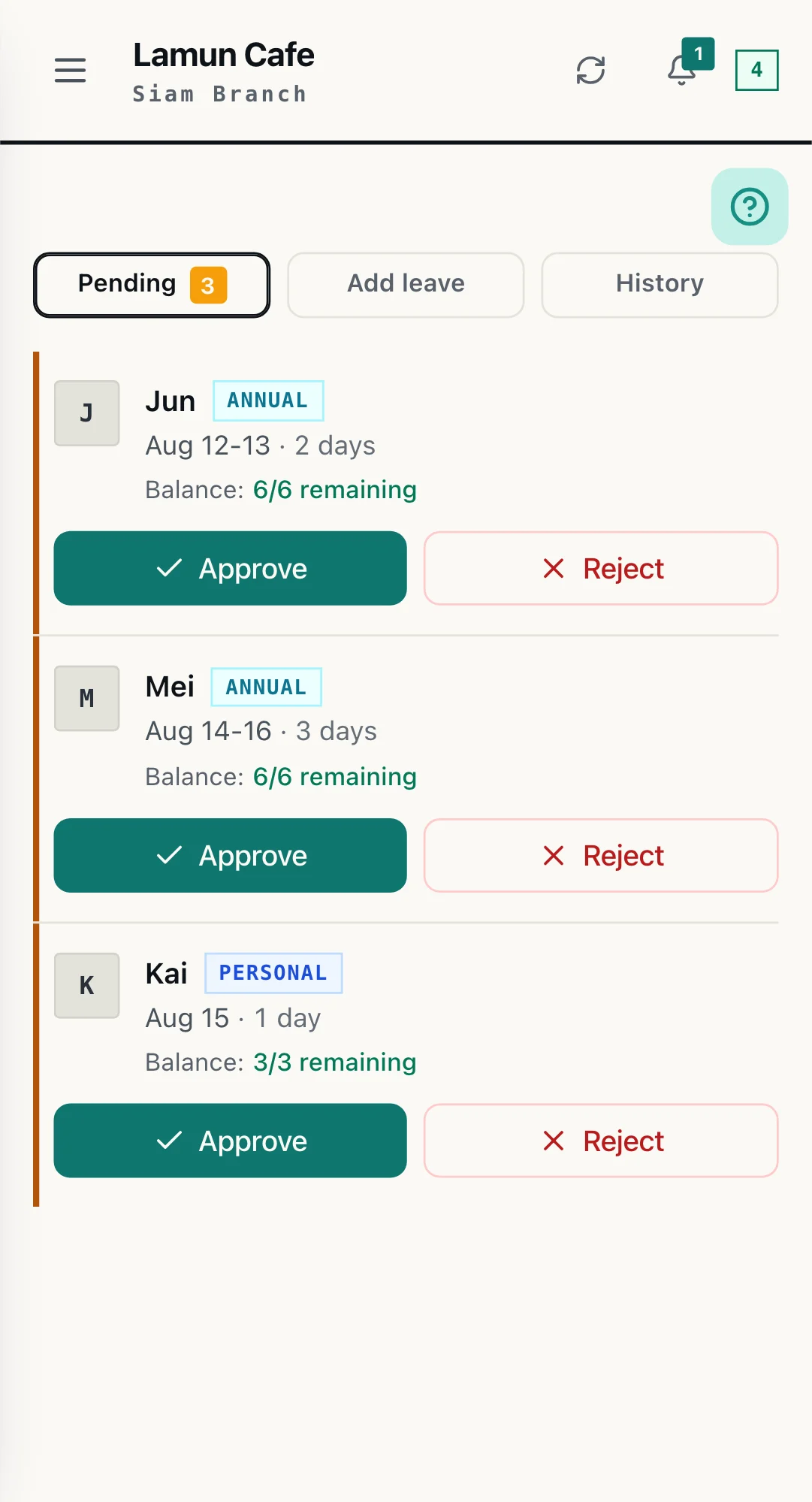
THE REAL SCREEN · LEAVE
Taiwanese WorkCo accounts carry the statutory leave types with a balance per type. Annual leave counts from each person's start date, staff request in LINE, the manager approves in the same place, and where you have agreed hourly leave the system counts in hours.
7. Where WorkCo helps, and where it does not
WorkCo helps with the counting: the statutory types, the balances, the start date as the anchor for annual leave, and the request and approval in LINE. What WorkCo does not decide is your policy: which year system, carry or pay out, and the leave unit written into your work rules. Those are decisions for you and your labour adviser.
Sources: Labor Standards Act Articles 38 and 50 (N0030001), Regulations of Leave-Taking of Workers (N0030006), Act of Gender Equality in Employment (N0030014) at law.moj.gov.tw, and the Ministry of Labor Q&A at mol.gov.tw, read on 2026-09-04.
Frequently asked questions
How is annual leave counted?
By continuous service from the start date: 6 months 3 days, 1 year 7, 2 years 10, 3 years 14, 5 years 15, and from 10 years one more day a year up to 30, under Article 38.
Does unused annual leave disappear?
No. It must be paid as wages, or by agreement carried one year and then paid if still unused. On resignation the remainder is paid.
Is sick leave paid?
Half pay for the first 30 days a year, counting ordinary and hospitalised sick leave together; beyond that the leave stands but there is no wage duty, under Article 4 of the leave regulations.
Can staff take leave by the hour?
Yes, if agreed and written into the work rules, except maternity leave which cannot be split. Balances are then held in hours.
Counted right, from the start date
Taiwanese WorkCo accounts carry the statutory leave types, a balance per type and annual leave counted from the start date, requested and approved in LINE. Free up to 15 employees.