The Floor · Taiwan
OVERTIME
How to calculate overtime pay in Taiwan (2026): weekdays, rest days, mandatory rest days and national holidays
The short answer: weekday overtime pays at least one-third more for the first 2 hours (about 1.34x) and two-thirds more for the next 2 (about 1.67x). Work on a rest day (休息日) earns at least an extra 1⅓ for the first 2 hours and 1⅔ after that, counted on actual hours. Work on a national holiday, with the worker's consent, is paid double. A mandatory rest day (例假) cannot be scheduled at all in the Ministry of Labor's reading: only a disaster, incident or emergency lets an employer suspend it, with double pay and a day off afterwards. The articles of law and worked examples follow.
This article is general education, not legal advice. Actual rates and calculations vary by case. Rely on the Labour Standards Act and the authorities' announcements, and consult a professional.
1. Weekday overtime
When staff work beyond their normal hours on a weekday, the extra hours are overtime. The common method is that the first 2 hours are paid at about one-third more per hour, roughly 1.34 times, and hours beyond that at about two-thirds more, roughly 1.67 times.
A worked example
Say the normal hourly wage is NT$200 and the worker does 3 hours of overtime. The first 2 hours are about 200 x 1.34 = 268 per hour, so about 536 for two hours. The third hour is about 200 x 1.67 = 334. The day's overtime is about 870. This is only an illustration. For the real figure, follow the law and the correct rounding.
2. Rest day work (休息日)
The rest day (休息日) is the flexible one of the two days off in 一例一休 (one mandatory rest day and one rest day every 7 days). If the worker agrees to work it, Article 24(2) of the Labor Standards Act requires an extra payment of at least 1⅓ of the weekday hourly wage for each of the first 2 hours, and at least 1⅔ from the third hour. Since 1 March 2018 it is counted on the hours actually worked; the old rule that 1 hour counted as 4 is gone. Rest-day hours also count toward the monthly overtime cap.
A worked example
A worker on NT$36,000 a month has a weekday hourly wage of 36,000 ÷ 30 ÷ 8 = NT$150. Three hours on a rest day: the first 2 hours are 150 × 1⅓ = 200 each, so 400; the third hour is 150 × 1⅔ = 250. The extra due is NT$650. The monthly salary already covers that day, so 650 is on top of it. For an hourly-paid worker you also pay the normal wage for those 3 hours, which is where the 2⅓x and 2⅔x figures come from.
3. Mandatory rest days and national holidays (例假日 / 國定假日)
The mandatory rest day (例假) is the compulsory day off in every 7. In the Ministry of Labor's reading it cannot be scheduled even if the worker agrees. Article 40 lets an employer suspend days off only for a natural disaster, incident or sudden emergency; the wage for that day is then doubled, a day off must be given afterwards, and the local authority must be told within 24 hours. So when you build the roster, fix the mandatory rest day first.
On a national holiday (國定假日), if the worker agrees to work, Article 39 doubles the wage: a monthly-paid worker receives an extra day's pay for up to 8 hours. At NT$150 an hour, 8 hours on a national holiday means an extra NT$1,200. Hours beyond 8 are paid at the Article 24 weekday overtime rates. If a national holiday falls on the worker's mandatory rest day or rest day, another day off must be given, on a date the employer and worker agree.
| Day | First part | After that | Article |
|---|---|---|---|
| Weekday overtime | First 2 h: +⅓ (≈1.34x) | Next 2 h: +⅔ (≈1.67x) | Art. 24(1) |
| Rest day (休息日) | First 2 h: an extra 1⅓ | From hour 3: an extra 1⅔ | Art. 24(2) |
| National holiday, with consent | Within 8 h: wages doubled | Beyond 8 h: weekday overtime rates | Art. 39 |
| Mandatory rest day (例假) | Cannot be scheduled | Disaster or emergency only: double pay + a day off | Art. 40 |
Taiwan overtime calculator (monthly-paid staff)
Enter the monthly salary and the hours to see the legal minimum extra pay. It starts at the 2026 minimum wage, NT$29,500 a month.
Overtime caps and comp time (補休)
Overtime plus rest-day work may not exceed 46 hours a month. With the consent of a union or a labour-management meeting it can reach 54 hours in a month, but no more than 138 hours over 3 months, and no day may exceed 12 hours in total (Article 32). A worker may choose comp time instead of overtime pay: it is hour for hour, 1:1, not multiplied. Hours not taken by the agreed deadline, or when the job ends, must be paid at that day's overtime rates (Article 32-1).
National holidays for workers in 2026
1/1, 2/15-2/19 (小年夜, Lunar New Year's Eve and the first three days of the New Year), 2/28, 4/4, 4/5, 5/1, 6/19, 9/25, 9/28, 10/10, 10/25 and 12/25. The 2025 amendment added 小年夜, Teachers' Day (9/28), Retrocession Day (10/25) and Constitution Day (12/25). The civil-service make-up days do not bind private employers. Minimum wage for 2026: NT$29,500 a month or NT$196 an hour, from 1 January 2026.
Checked against official sources on 27 September 2026: the Labor Standards Act (勞動基準法), Articles 24, 32, 32-1, 36, 39 and 40, and Enforcement Rules Article 23-1; the Ministry of Labor FAQs on the hourly wage of a monthly-paid worker (salary ÷ 30 ÷ 8) and on work on a mandatory rest day (1, 2); and the 2026 minimum wage announcement.
4. Why hand calculation is risky
The problem is not that the multipliers are hard. It is that you first have to classify correctly which hours are weekday overtime, which are rest-day work, and which segment those hours fall into. For a multi-branch chain with hundreds of people, classifying and multiplying by hand every month is where mistakes happen most, and an overtime mistake is a direct breach of the law.
Correct overtime starts with correctly counted hours, not with a month-end guess.
WorkCo calculates each person's hours and overtime from the shifts actually sent, and exports a report for accounting to continue with, cutting the month-end manual sorting and multiplying. But the system is only a tool. Choosing the correct rate, interpreting the law and the responsibility to pay remain with you and your advisers. Always follow the Labour Standards Act and the authorities' announcements.
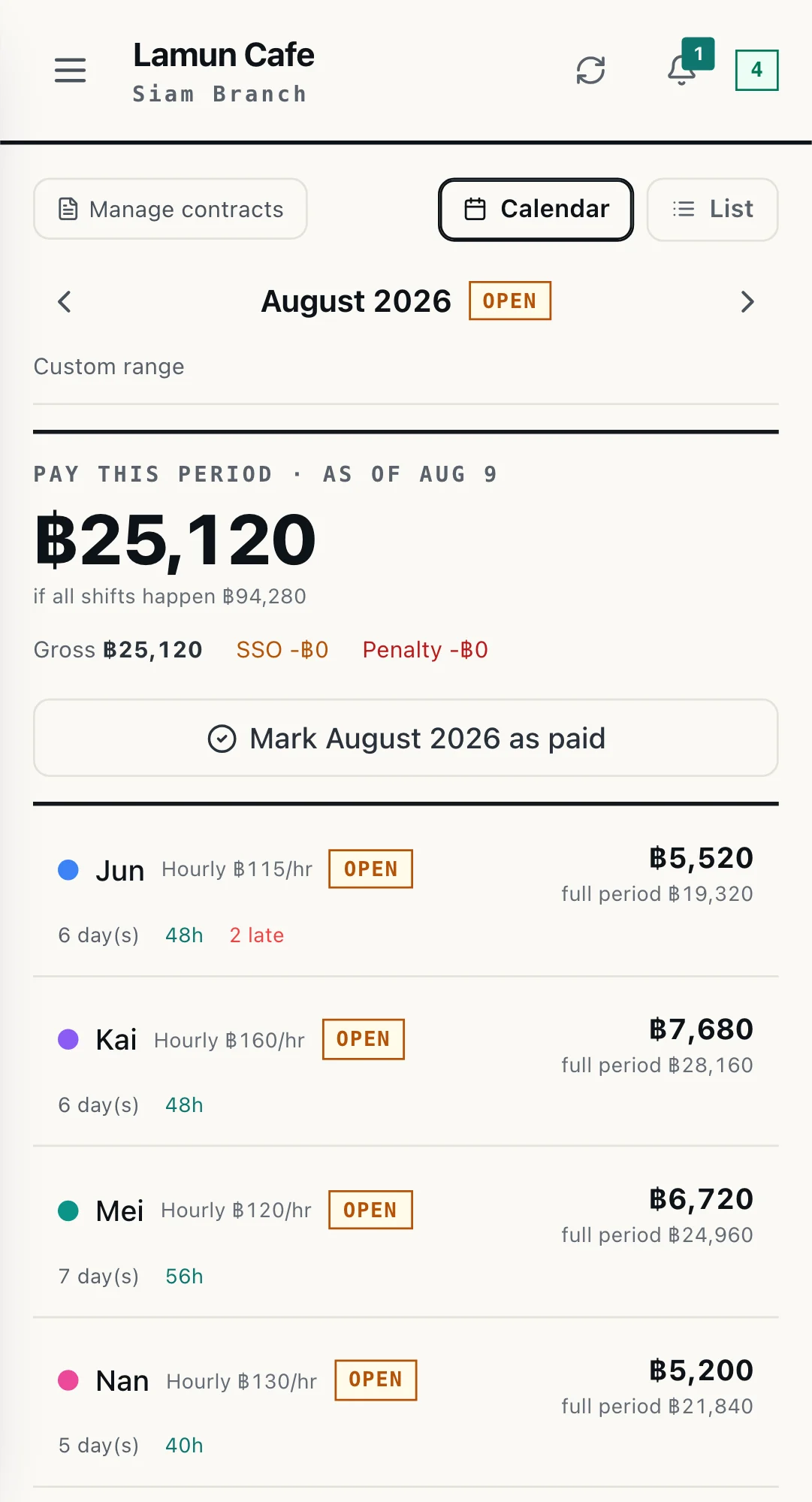
THE REAL SCREEN · PAYROLL (PAID PLANS)
Hours and overtime are calculated from the shifts actually sent, rather than added up by hand at the end of the month.
Frequently asked questions
How is weekday overtime calculated?
For weekday overtime, the common method is that the first 2 hours are paid about one-third more per hour, roughly 1.34 times, and hours beyond that about two-thirds more, roughly 1.67 times. Example: at an hourly wage of NT$200, the first 2 hours are about 268 an hour and the third hour on is about 334 an hour. For the actual rates and method, follow the Labour Standards Act and the authorities' announcements, and confirm with a professional.
Is flexible rest day overtime the same as a weekday?
No. On a rest day (休息日) the first 2 hours earn an extra payment of at least 1⅓ of the weekday hourly wage, and from the third hour at least 1⅔, counted on actual hours (Article 24(2)). At NT$150 an hour, 3 hours on a rest day means an extra NT$650.
How are mandatory rest days and public holidays calculated?
A mandatory rest day (例假) cannot be scheduled even with the worker's consent, in the Ministry of Labor's reading; only a disaster, incident or emergency under Article 40 allows it, with double pay and a day off afterwards. A national holiday (國定假日) worked with the worker's consent is paid double under Article 39 for up to 8 hours, and weekday overtime rates apply beyond 8.
Are the overtime multipliers fixed?
The 1.34 and 1.67 figures in this article are commonly cited, but real application varies with the situation, the flexible working-hour scheme and the authorities' latest announcements. Overtime is not a permanently fixed number. When calculating, follow the Labour Standards Act and the authorities' announcements, and confirm your case with a professional, so you do not breach the law by applying an outdated or inapplicable rate.
Can a system calculate overtime automatically for me?
It can help, but you still need to confirm. WorkCo calculates each person's hours and overtime from the shifts actually sent and exports a report for accounting to continue with, cutting month-end errors from manual sorting and multiplying. But the system is only a tool. Choosing the correct rate, interpreting the law and the responsibility to pay remain with you and your advisers, and you should follow the Labour Standards Act and the authorities' announcements.
Can staff work on a mandatory rest day (例假)?
Normally no. The Ministry of Labor treats it as off limits even if the worker agrees. The exception is a natural disaster, incident or sudden emergency under Article 40, with double pay, a day off afterwards and a report to the local authority within 24 hours.
What is the monthly overtime limit in Taiwan?
46 hours a month, including rest-day work. With union or labour-management meeting consent it can be up to 54 hours in a month, but no more than 138 over 3 months, and never more than 12 hours of work in a day (Article 32).
Can overtime be taken as comp time (補休)?
Yes, if the worker chooses it and the employer agrees. It is hour for hour, 1:1, not multiplied. Hours not taken by the agreed deadline, or when the job ends, must be paid at that day's overtime rates (Article 32-1).
What are Taiwan's national holidays for workers in 2026?
1/1, 2/15-2/19, 2/28, 4/4, 4/5, 5/1, 6/19, 9/25, 9/28, 10/10, 10/25 and 12/25. The 2025 amendment added 小年夜, Teachers' Day, Retrocession Day and Constitution Day. If one falls on a worker's mandatory rest day or rest day, another day off must be given.
Get the hours right at the source
WorkCo calculates hours and overtime from the shifts actually sent, and produces a report ready for accounting. WorkCo is free in Taiwan up to 15 employees, so you start in LINE.