The Floor · Taiwan
LABOUR-LAW BASICS
Labour-law scheduling 101: rest days, public holidays and overtime, understood in one read
The short answer: a legal roster in Taiwan gives each worker one mandatory rest day and one flexible rest day in every 7 days, respects public holidays, and stays within the normal limits of 8 hours a day and 40 hours a week. This guide explains those rules in plain language for chain owners.
This article is general education, not legal advice. Every business is different. Please rely on the Labour Standards Act and the Ministry of Labor's announcements, and consult a labour-law professional for your own case.
1. The core rule: one mandatory rest day, one flexible one
The rule at the heart of Taiwan scheduling is "one rest, one flexible rest". In every 7 days, each worker must have two days off. One is a mandatory weekly rest day, and the other is a flexible rest day. This is the most basic red line every roster must not cross.
The mandatory weekly rest day
The mandatory rest day is a full day off. As a rule, staff cannot be made to work it, except for the specific exceptions the law sets out. When scheduling, lock this day first, then arrange the other days around it.
The flexible rest day
The flexible rest day is more open. With the worker's agreement they may work it, but you must pay the higher flexible-rest-day rate. For restaurants and retail that are busy at weekends this day is useful, but the wage must be calculated correctly.
2. Public holidays
Public holidays are days that should be off by law. If operational need means staff work a public holiday and they agree, you must pay the legally added wage. During long weekends chains are often short-staffed, so mark the public holidays clearly from the start to avoid missing the extra pay. For the actual holiday list and how to pay, rely on the announcements of the Ministry of Labor and the relevant authorities.
3. Normal working-hour limits
Under the Labour Standards Act, normal working hours are, as a rule, no more than 8 hours a day and 40 hours a week. Anything beyond that is overtime, which must be paid at the required rate, and daily and monthly overtime hours have their own caps. These rules shape how your normal roster should be designed, before overtime even comes up.
Flexible working-hour schemes
Some businesses use flexible working-hour schemes, redistributing normal hours over, for example, two, four or eight weeks to suit the business cycle. But this can only be used under the conditions and for the business types the law allows. It is not something you can adjust freely. If you plan to use it, confirm with a professional first.
4. Putting it together: what a legal roster looks like
The safest scheduling order is: one, lock each person's mandatory rest day first. Two, place the flexible rest day. Three, mark the public holidays. Four, fill normal shifts without exceeding 8 hours a day and 40 a week. Five, only if you truly need more, count it as overtime or rest-day work at the correct rate. Follow this order and the roster is far less likely to break the rules.
A legal roster does not start with calculating overtime. It starts with placing the rest days correctly from the very beginning.
Keeping every branch's roster legal by hand is very easy to get wrong, especially for a multi-branch chain. WorkCo helps you build a schedule where each person's rest days and hours are clear, and it calculates hours and overtime from the shifts actually sent. But the system is only a tool. The legal responsibility and interpretation remain with you and your professional advisers.
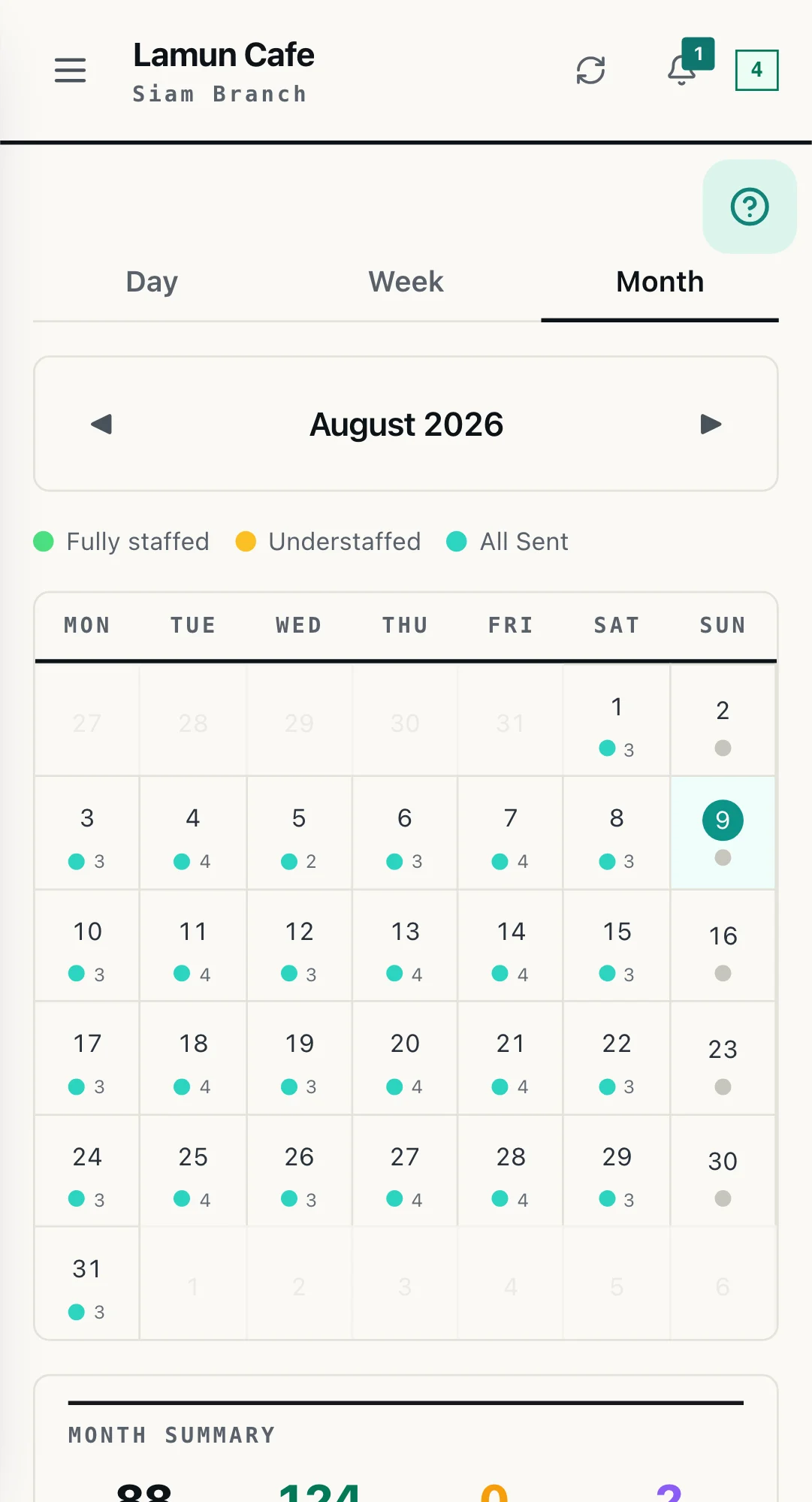
THE REAL SCREEN · MONTH VIEW
The month view lays the whole month out: how many people are on each day and which days have been sent, so a rest day does not quietly get rostered over.
Frequently asked questions
What does "one rest, one flexible rest" mean?
It means that in every 7 days a worker must have two days off, one mandatory rest day and one flexible rest day. The mandatory day is a full day off that, as a rule, cannot be worked. The flexible day is more open: with the worker's agreement it can be worked, but at the added wage the rules require. This is the most basic red line in scheduling.
What is the difference between the mandatory and flexible rest day?
The mandatory rest day is a full day off in every 7 days that, as a rule, cannot be worked, except for the legal exceptions. The flexible rest day is more open: with the worker's agreement it can be worked, but the wage must follow the flexible-rest-day rate. When scheduling, lock the mandatory day first, then place the flexible one. That is the safest approach.
What is the normal working-hour limit?
Under the Labour Standards Act, normal working hours are, as a rule, no more than 8 hours a day and 40 hours a week. Anything beyond that is overtime, which must be paid at the required rate, and daily and monthly overtime hours have their own caps. Under a flexible working-hour scheme the distribution of normal hours can be adjusted, but it must still meet the legal conditions.
What should I watch for when scheduling on public holidays?
Public holidays should be days off by law. If operational need means staff work one and they agree, you must pay the legally added wage. Chain restaurants and retail are often short-staffed over long weekends, so mark public holidays clearly from the start to avoid missing the extra pay. For the actual holiday list and payment method, rely on the announcements of the Ministry of Labor and the relevant authorities.
What happens if the roster breaks the law, and who decides?
If the roster conflicts with one-rest-in-seven, the hour caps or the overtime rules, the employer may face penalties from the authorities and a duty to pay back wages. This article is general education, not legal advice. Your specific case, including whether a flexible-hour scheme applies or whether industry exceptions exist, should follow the Labour Standards Act and the announcements of the authorities (the Ministry of Labor and local labour offices), and you should consult a labour-law professional.
Let the schedule help keep it legal
WorkCo lets you build a schedule where each person's rest days and hours are clear, and calculates hours and overtime from the shifts actually sent. WorkCo is free in Taiwan up to 15 employees, so you start in LINE.