The Floor · Taiwan
SCHEDULING · 2026
Free staff roster template for Taiwan shops (2026)
In Taiwan, a staff roster template needs each person's name, role, store and daily shift times, with one regular day off (例假) and one rest day (休息日) marked for every person in every 7 days, under Labor Standards Act art. 36. Once the week is built, check three limits: normal hours of at most 8 a day and 40 a week (art. 30), at most 12 hours a day including overtime (art. 32), and at least 11 consecutive hours of rest when a rotating shift changes (art. 34). Below: a free CSV template for Excel or Google Sheets, a worked one-week roster for a 5-person shop, and Excel, a LINE group and a scheduling app compared.
This is a summary of the law, not legal advice. The article text is from Taiwan's national laws database (全國法規資料庫), read on 2026-11-23.
1. What columns does a roster need?
A good roster shows at a glance who works where and when, and lets you see whether the week is legal. It needs these columns:
- Name (姓名). One row per person.
- Role (職務). Shift lead, staff, part-time, so you see whether someone who can open up or close the till is on.
- Store (門市). With two or more stores, where each person works.
- Date and weekday. Monday to Sunday, with the dates of that week.
- Shift start and end. Write 10:00-19:00, not "early", because hours are counted from the times.
- Break. Art. 35: after 4 hours of continuous work, at least 30 minutes of rest (for rotating shifts or continuous or urgent work, the employer may arrange it differently within working hours). Write it after the shift, for example "break 60 min".
- 例假 and 休息日 marked per person. Mark which day is each person's regular day off and which is their rest day, because the two follow different rules. More in regular day off vs rest day in Taiwan.
- Weekly hours (本週工時). One cell per person, to check against 40.
- Notes. Leave, shift changes, cover at another store.
2. Free roster template download
Here is a free roster template: download the roster template (CSV). The file is in Taiwan Chinese. It opens straight in Excel; in Google Sheets, choose "File > Import" and upload it.
What is in the file:
- Columns for name, role and store, then Monday to Sunday, with a date row.
- Five example staff (員工A to 員工E), with cells written as "10:00-19:00", "例假" and "休息日".
- A weekly hours column left blank for you to fill in.
- Four lines at the bottom: the rules of art. 36, 32, 30 and 34, one line each.
Replace the examples with your team, then save it as an Excel file (.xlsx) before you keep working in it, because a CSV file does not keep formulas or formatting.
3. How do I make the roster legal? A checklist
When the week is built, go through these six checks, row by row. Each one comes from an article of the Labor Standards Act.
| Check | Article | How to see it on the roster |
|---|---|---|
| 2 days of rest in every 7: one 例假, one 休息日 | Art. 36 | In each row, count one "例假" and one "休息日" in the 7 days. |
| Normal hours: at most 8 a day, 40 a week | Art. 30 | After the break, no day is over 8 hours, and the weekly hours cell is 40 or less. |
| Normal hours plus overtime: at most 12 a day | Art. 32 | On a day with overtime, the total is 12 or less. Overtime needs union consent or, with no union, a labour-management meeting (勞資會議). |
| Overtime: at most 46 hours a month | Art. 32, 36 | With union or labour-management meeting consent: 54 a month and 138 in every 3 months. Hours worked on a 休息日 count toward this total (art. 36). |
| Rotating shifts change once a week, with at least 11 consecutive hours of rest at the change | Art. 34 | When you move someone from a late shift to an early one, count from the end of one shift to the start of the next. |
| 4 hours of continuous work: at least 30 minutes of rest | Art. 35 | Every shift longer than 4 hours has a break written in. |
Art. 30, paragraph 1, in English: a worker's normal working hours may not exceed 8 a day or 40 a week.
Art. 34, paragraphs 1 and 2, in English: rotating shifts change once a week unless the worker agrees otherwise, with at least 11 consecutive hours of rest at each change, or not less than 8 where the central authorities announce it for the nature of the work or special reasons. Paragraph 3 requires union or labour-management meeting consent for the lower figure.
Breaking art. 30 paragraphs 1 to 3, art. 32 or art. 34 to 41 carries a fine of 20,000 to 1,000,000 New Taiwan dollars under art. 79. How overtime is paid is in how to calculate overtime pay in Taiwan.
4. A worked roster: a shop open 7 days, five on and two off, or six on and one off?
A worked example, not a real shop.
The shop opens every day from 10:00 to 22:00, with 4 full-time staff and 1 part-timer. The early shift is 10:00-19:00 and the late shift 13:00-22:00, each with a 1-hour break, so 8 hours of work. The part-timer works 11:00-15:30 with a 30-minute break, so 4 hours. Days off are staggered, so every day has at least one person on the early shift and one on the late shift.
| Staff | Mon | Tue | Wed | Thu | Fri | Sat | Sun | Hours |
|---|---|---|---|---|---|---|---|---|
| 員工A, lead | 例假 | 休息日 | Early | Early | Early | Early | Early | 40 |
| 員工B, staff | Early | Early | 例假 | 休息日 | Early | Early | Early | 40 |
| 員工C, staff | Late | Late | Late | 例假 | 休息日 | Late | Late | 40 |
| 員工D, staff | 例假 | 休息日 | Late | Late | Late | Late | Late | 40 |
| 員工E, part-time | Mid | Mid | 例假 | Mid | 休息日 | Mid | Mid | 20 |
Early = 10:00-19:00, Late = 13:00-22:00, Mid = 11:00-15:30 (part-time). Each row was checked:
- Everyone has one 例假 and one 休息日 in the 7 days (art. 36).
- In this example the full-time staff work 8 hours a day, 40 hours a week, within the art. 30 limit; the part-timer works 4 hours a day, 20 hours a week.
- There is no overtime this week, so the art. 32 limits are untouched.
- Nobody changes shift this week. If 員工C moves from late to early next week: off at 22:00, in at 10:00 the next day, a 12-hour gap, which passes the 11 hours of art. 34.
- Every shift has a break (art. 35).
- Staff per day: 3 from Monday to Friday, 5 on Saturday and Sunday.
So is six on, one off allowed? The basic rule of art. 36 is 2 days of rest in every 7. If the sixth day means working someone on their 休息日, those hours count toward the art. 32 overtime total (art. 36), and art. 24 adds pay on top: at least an extra 1⅓ of the normal hourly wage for the first 2 hours, and at least an extra 1⅔ after that. A 例假 cannot be scheduled for work, except for the natural disasters, incidents or emergencies of art. 40. The full 一例一休 explanation is in labour-law scheduling 101.
5. How do I roster part-time staff?
Part-time staff are workers too. Art. 36 says 「勞工每七日中應有二日之休息」 (a worker has 2 days of rest in every 7 days) and does not separate full-time from part-time, so a part-timer's row also needs a 例假 and a 休息日 in every 7 days.
- Hourly pay. Most part-timers are paid by the hour. Art. 24 works out rest-day pay from the normal hourly wage (平日每小時工資額), and hours past the 8 normal hours of a day are overtime (art. 24, 32).
- Breaks. Art. 35 applies to part-timers as well: 4 hours of continuous work needs at least 30 minutes of rest.
- Real times on every shift. Part-time shifts are often short and uneven: write the start and end of each, so the month's hours add up.
A part-timer's days, hours and pay follow their own employment contract. If you are not sure, ask your local labour office or a professional.
6. Excel, a LINE group or a scheduling app: what is the difference?
When we talk to shop owners, the answer we hear most is that they roster in Excel, on paper or in a LINE group. Each works; each does a different job.
| Method | What it does well | What it does not do |
|---|---|---|
| Excel or Google Sheets | Costs nothing, familiar, any layout you like, easy to keep on file. | Does not send each person their own shifts, does not check 一例一休 unless you write the formulas, does not record real start and end times. |
| Roster posted in a LINE group | Everyone is already in LINE; one screenshot is fast. | Changes get buried under chat and stickers, everyone sees everyone's shifts, you cannot tell who has seen the new version, and a screenshot is not an attendance record. |
| Scheduling app | Each person sees their own shifts, changes are notified, and some include clock-in and leave too. | Takes setup time; some need every staff member to install an app and set a password; prices and plans differ, so read them before you start. |
When all three are mixed, the time goes into making them agree. If you are choosing an app, see choosing scheduling software in Taiwan, 2026.
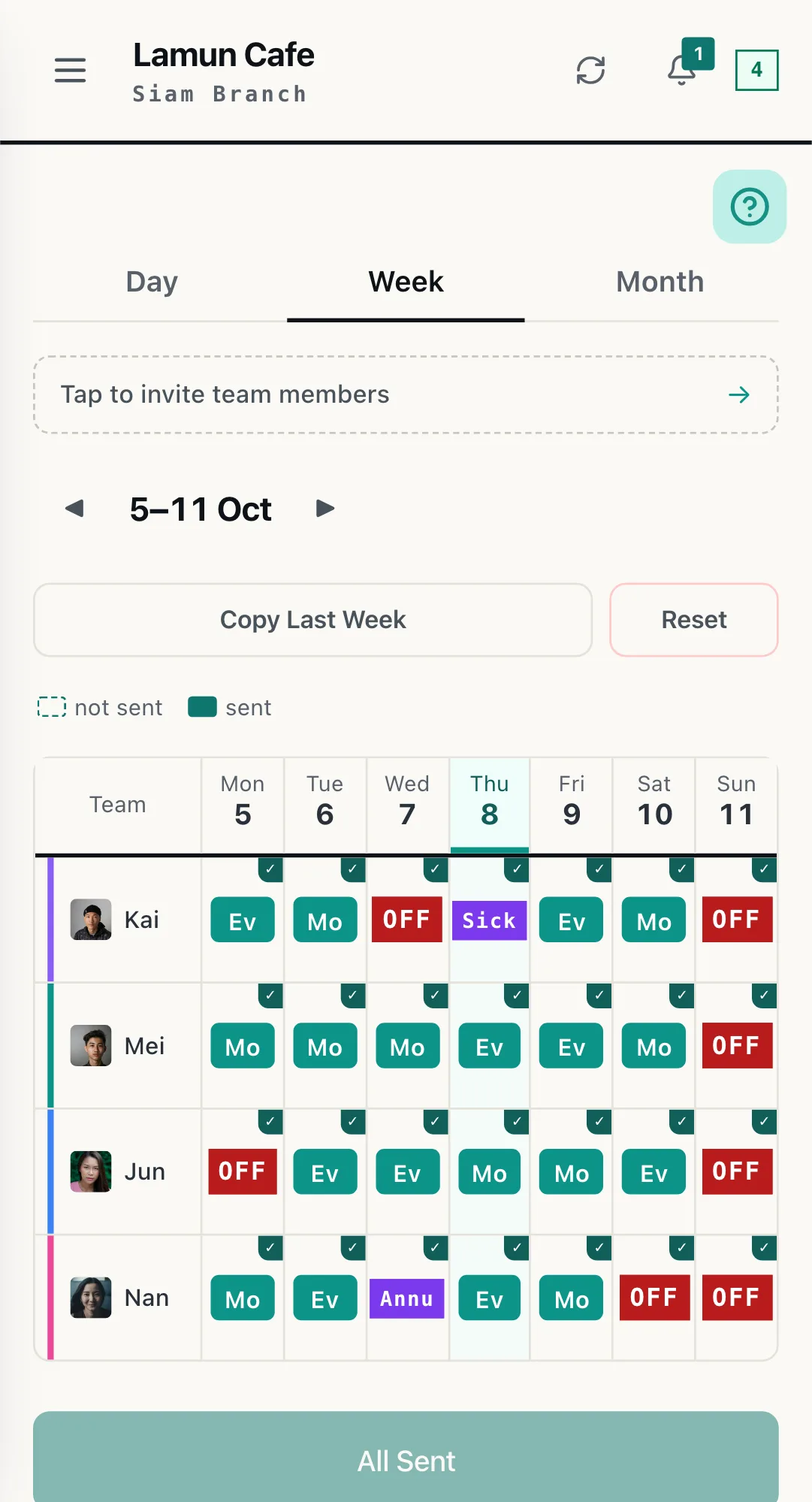
THE REAL SCREEN · SCHEDULE
In place of the Excel file and the group chat, the whole week sits in one grid. Copy last week, then send once.
7. From the template to LINE: rostering with WorkCo
WorkCo runs inside the LINE your team already uses. The week from the template moves into a weekly grid and reaches every person.
- Tap to assign. Tap a cell in the weekly grid to assign a shift. Daily, weekly and monthly views, with several stores, roles and shift types.
- Copy Last Week. Bring last week's shifts in as a draft, change what is different, then send.
- Each person gets their own shifts in their own LINE. When a shift changes, it is sent again, with no digging through a group chat.
- 劃休 (monthly day-off picking) in LINE. In Taiwan, staff pick next month's days off in LINE. How it works: the 劃休 guide.
- Leave in LINE. Staff ask for leave and managers approve it in LINE, with a balance per leave type.
- GPS check-in. Staff check in on their own phone inside each store's radius, and attendance exports to Excel.
The steps are in the scheduling guide. WorkCo is free forever for small teams; bigger teams get 60 days free, every feature. Start free.
You can also do this on a computer: WorkCo opens in any web browser, signed in with LINE, and on a wide screen the menu stays open on the left.
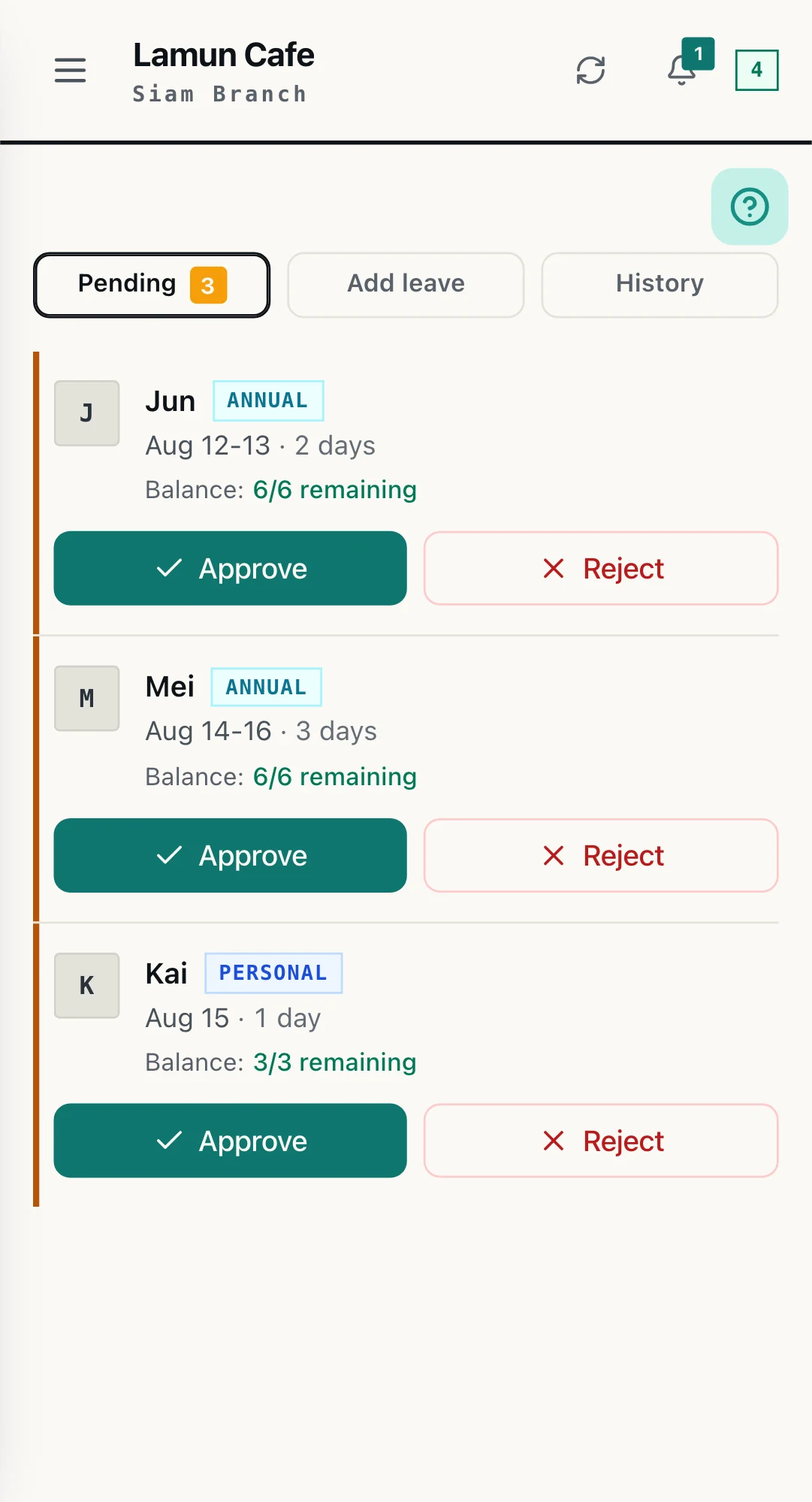
THE REAL SCREEN · LEAVE
Staff request leave in LINE, and the manager approves or rejects in one place, with the remaining balance shown alongside.
8. Frequently asked questions
How do I make a staff roster in Excel?
One row per person, with columns for name, role and store, then Monday to Sunday. Type each shift as a start and end time, mark 例假 (regular day off) and 休息日 (rest day) in each row, and add a weekly hours column. The free template on this page is laid out this way.
Is there a free roster template I can download?
Yes. The CSV template on this page is free, with 5 example staff, a Monday to Sunday week, a weekly hours column and four Labor Standards Act rules at the bottom. It opens in Excel or Google Sheets.
Does every week need a regular day off and a rest day?
Yes, as the basic rule. Under Labor Standards Act art. 36, a worker has 2 days of rest in every 7 days: one regular day off (例假) and one rest day (休息日). The same article sets other patterns for employers who rearrange normal hours under art. 30 or art. 30-1; read the article before using them.
How many hours apart must two shifts be?
When a rotating shift changes, Labor Standards Act art. 34 requires at least 11 consecutive hours of rest. For cases the central authorities announce, it may be not less than 8 consecutive hours, with union or labour-management meeting consent. Example: a shift ending at 22:00 and the next starting at 09:00 the following day gives exactly 11 hours.
Can I send the roster in a LINE group?
Yes, the law does not forbid it. In practice a later change sits under other messages, everyone sees everyone's shifts, and you cannot tell who has seen the new version. A screenshot of the roster is also not an attendance record, which the law asks you to keep to the minute.
How long do I have to keep the roster?
Labor Standards Act art. 30 sets the rule for attendance records (出勤紀錄), not for the roster: attendance recorded day by day to the minute, and kept for 5 years. Keeping each month's roster next to the attendance records makes the two easy to check against each other. The details are in our article on keeping attendance records for five years.

Download the template and build this week. When you want each person to get their shifts in their own LINE, add us on LINE and talk to a real person on our team.